Showing posts with label history. Show all posts

Saturday, January 20, 2018

A Year Later

It's been a year, and I'm still not sure how to responsibly write about Inauguration Day, or the Women's March, or even the whole last year. I've tried, yes, but it always comes back to the same question: what do I genuinely have to offer to this discussion? And is that question itself even worth exploring publicly?

Maybe I'll figure that out soon. For now, I'll step aside and direct my listening toward groups like Higher Heights and INCITE!, each of whom are working hard to empower women of color and trans/non-binary folks. If you can relate to any of the above sentiments, consider learning more about the activism happening in and around your communities. And if you're aware of any orgs doing work important to you, shoot me an email. I'd love to hear more.

With that, I'm off my soapbox.

Thanks for reading.

Workers clean up debris from the vandalism performed by self-proclaimed "anarchists" near D.C.'s Franklin Square; Jan. 20, 2017

Monday, October 30, 2017

Plan 9 from Outer Space

In the spirit of Halloween, I thought I'd share one of my favorite (non-) scary movies: Plan Nine from Outer Space. It's a delight, and an absolute disaster.

The film is remarkable for several reasons. Aside from being known as one of the "worst" movies ever made, it's the last film to feature actor Bela Lugosi (the guy who played the O.G. Dracula in 1931). Lugosi died before production really took off, so director Ed Wood hired a random actor to replace him. Wood still had footage of Lugosi, however, and he opted to simply splice the two actors' performances together.

Most audiences were unimpressed.

Now the movie has a quasi-legendary status. Almost everything about it is, by conventional standards, terrible. The acting, the writing; the production. Even when I first watched this as a naïve and impressionable six-year-old, I knew it was not a well-made movie. But that's its whole charm: as ridiculous a film this might be, it never takes itself too seriously.

For your enjoyment and chagrin, here's the whole thing.


- Plan 9 from Outer Space (1959), directed by Ed Wood

Thursday, October 12, 2017

Sudden Impact

Last Friday night, I took a walk to Gillham Park and wandered around the storied old wading pool.

Built in 1977, it replaced an earlier wading pool from 1913. Because this was Kansas City in the '70's, the new pool was heavily informed by Modernist architecture: lots of low, flat, rectilinear concrete planes lead gradually into the shallow pool, which was only three feet at its deepest. This practical design meant that, though there wasn't much shade, parents and friends could nestle into the elevated concrete corners with a clear view of swimmers. It also allowed for closer proximity among strangers, as the segmented planes dictated a certain degree of personal space while still allowing visitors to sit close to one another and, perhaps, strike up a conversation. By many accounts, people felt safe and relaxed here, like they were part of a community.

The pool, which lacked a pumping and filtration system, was eventually shut down last summer after its thirty-ninth year. This represented, for many folks, a significant loss. Gillham Park had one of the few free pools in the city, which meant that it was accessible across socioeconomic boundaries. It was seen as a friendly and welcoming neighborhood space.

Neighborhood groups are currently working to raise money for a nearby spray park. This potential project would be an adequate replacement for the beloved pool, which now sits empty. Its plain white interior has become a free canvas for local artists and bored kids. Though I doubt the pool will remain the gathering space it once was, I'll watch these walls nonetheless.


"Bouncy bouncy—it's such a good time"

Southbound

Thursday, September 21, 2017

The Value of Poetry

Some scrambled thoughts before an appointment:

Our culture has always impressed upon me the value of hard work. As a self-proclaimed "poet," I hold no illusions about the imposed financial value of my work. I will never pay my bills writing poetry, and I am okay with that. I remind myself that many writers had trying day jobs: Maya Angelou was a cable car conductor. John Clare was a thresher. Junot Díaz worked in a steel mill.

As a young professional, though, I'm struggling more and more to find the balance between my types of work. My full-time job pays my bills. My unpaid volunteer work at New Letters on the Air helps me endure the full-time job, and may one day help me step into a paying job that I love. I'm beyond happy to be there, even if it means working longer hours. But after all those hours, I'm exhausted. I don't want to write. I don't even want to be around my friends. I just want to stay in and watch Curb Your Enthusiasm until it's time to go to bed and start the whole process over.

This is the hard work that everyone keeps talking about.

In today's America, where we value labor solely based on its economic worth, how are artists supposed to do their damn jobs? (And what of the artists who aren't nearly as privileged as I am?) When did we cease to champion creative endeavors? The answer, of course, is that we never much valued artists' contributions, at least not in the same way we value bankers' and lawyers'. And that's a problem. Art is the lens through which we see ourselves, as a collective and as individuals. It helps us find versions of the truth, most importantly those truths that are not quite comfortable or easy. That perspective is priceless.

Last Friday at New Letters, we were pulling together a show with writer Judith Ortiz Cofer, and she described her routine of waking up at 5 a.m. every morning to write, simply because it was the only time she could find. She sacrificed sleep and relationships to be able to find those hours, which is strangely comforting. Her priorities are evidence—to me, anyway—that it's impossible to have everything, and that that is okay. (I'm looking at you, Sheryl Sandberg.)

I'm trying hard myself to be comfortable with those sacrifices. Eventually, I'll get there.

You can hear this week's show here if you're interested.

As always, thank you for reading.

Thursday, July 27, 2017

Retrospectively

It sounds like an overwrought and clichéd story: tortured artist kills himself after the death of his girlfriend.

This was the case for Jeremy Blake, who allegedly walked into the ocean and drowned himself. A week earlier, he'd found his girlfriend, blogger and video game designer Theresa Duncan, dead in the apartment they shared above St. Mark's Church (which has its own fascinating history). According to friends, the couple had been acting erratically. They told stories of being followed and harassed by Scientologists, and went so far as to make their friends sign loyalty pledges to ensure they weren't agents of Scientology. In short, she and Blake were both scared, and they didn't seem to be in good health. Their loved ones were worried, but no one had expected their deaths, just a week apart in July of 2007.

Blake and Duncan in Venice, CA, photographed by Bret Haller

It would be impossible to sit here and give a concrete reason for their suicides, which, like most, are shrouded in uncertainty. The mystery behind their deaths has overshadowed any creative successes they achieved, as evidenced by not only this blog post, but several trendy magazine profiles published after they died. (Here is one from Vanity Fair, and another from New York Magazine.)

The work they left behind, I'd argue, is a far more compelling and enriching glimpse of what and how they thought. With that in mind, here are pieces of their work: a series of video games produced by Duncan for young female audiences, and a digital video made by Blake and inspired by Sarah Winchester.

- - -


- "Winchester Redux," by Jeremy Blake (2004)

Tuesday, June 13, 2017

The Emperor's New Clothes

Way back in the nineteenth century, Hans Christian Andersen wrote a short story called "The Emperor's New Clothes." (If you're interested, the English translation can be found here.)

The basic vibe, in case you're not inclined to read it, is that these weavers promise to produce magic clothes for an emperor. The weavers tell him that his clothes will appear invisible to anyone who's unworthy. Then the weavers commit some fantastic object-work, pretending to clothe the emperor without actually clothing him. (These weavers probably would have been great at improv. Perhaps they were court jesters in disguise?)

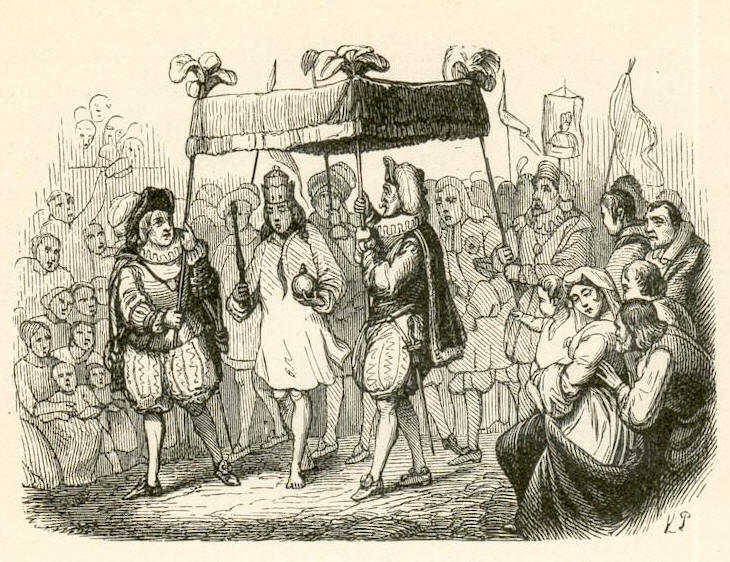
The Emperor, as illustrated by Vilhelm Pedersen

As you might have guessed, their little experiment yields some unsettling results: no one wants to tell the emperor he's naked, because they're afraid he'll condemn them.

Sound familiar?

Jeff Sessions's testimony before the Senate Intelligence Committee was like a sad, Billy Wilder sequel to that story. The way he squirmed in his seat, equivocating about laws and duties...it was clear he knew he was wrong. Furthermore, I suspect he knows that Trump is wrong, too—surely Jeff Sessions isn't that dumb. But throughout his testimony, I had a tingling suspicion that, no matter what happens, Sessions will take the fall for Trump. He is going down with that ship, no matter what the price.

I'm not saying Sessions didn't break the law, or that his politics aren't repugnant. What I am saying is that Sessions will stop at nothing to protect Trump, even if it means obstructing federal investigations. This frightens me. Is our democracy really so broken that we can't elect leaders who support us?

I don't think so.

I think that, speaking generally, the Russian interference in our 2016 presidential election was an attempt to undermine American faith in our democracy. It's not a perfect system, of course. But if this election has taught us anything, it's that we need to charge unflinchingly ahead within the framework of our existing system. We need to vote, and we need to elect leaders who want us to vote, too. We need leaders who will listen to their constituents and who will accordingly challenge the structure of our government. We need leaders who will speak truth to power, who will modestly admit their shortcomings, who will always strive for a better country.

Throughout this whole post, however, I'm circling the question I don't have an answer to: what about the damn weavers? What's their role in this? Instinct tells me that these weavers are heroes, for several reasons:
  1. They outsmart the all-powerful emperor.
  2. They draw attention to the societal inclination to affirm authority figures.
  3. They're really good at pretending to weave.
Still, I can't place them in the context of our current political situation. Are our weavers the Russian government? Or maybe all the people who neglected to vote? Or maybe even the old white men who wrote our Constitution so long ago? Most of these figures aren't heroes.

Then again, maybe it's time to revise our conceptions of fairy tales.

Sunday, February 19, 2017

Garlic Is as Good as Ten Mothers

The title says it all.


- Garlic Is as Good as Ten Mothers by Les Blank (1980)

Tuesday, September 6, 2016

Lying in Grass

I was in the middle of drafting a meandering rumination on the tragedies in Hermann Hesse's life, and then I thought better of it. Sure, lots of sad stuff happened in his life (he had severe depression and his wife was schizophrenic, which probably only exacerbated their myriad marital problems). Despite this, Hesse managed to write a lot of insightful, challenging work, and it seems reductive to focus on one already-overemphasized aspect of his life.

Siddhartha was his first work that I ever read, and the memory of experiencing that book still rests fresh in my recollection. I was just beginning my second semester of college, and I thought I knew everything. That book helped set me straight. It was one of the catalysts to my decision to study writing. It's short and stylistically straightforward, so I recommend it to any reader looking for a brief and enlightening novel.

Digressions aside, Hesse is lesser-known as a poet. The first English-translated collection of his poems was published in 1970, which posthumously afforded Hesse greater recognition for his precise poetic abilities. Here is one of those poems, translated from German by the American poet James Wright.

"Lying in Grass"
Is this everything now, the quick delusions of flowers,
And the down colors of the bright summer meadow,
The soft blue spread of heaven, the bees' song,
Is this everything only a god's
Groaning dream,
The cry of unconscious powers for deliverance?
The distant line of the mountain,
That beautifully and courageously rests in the blue,
Is this too only a convulsion,
Only the wild strain of fermenting nature,
Only grief, only agony, only meaningless fumbling,
Never resting, never a blessed movement?
No! Leave me alone, you impure dream
Of the world in suffering!
The dance of tiny insects cradles you in an evening radiance,
The bird's cry cradles you,
A breath of wind cools my forehead
With consolation.
Leave me alone, you unendurably old human grief!
Let it all be pain.
Let it all be suffering, let it be wretched-
But not this one sweet hour in the summer,
And not the fragrance of the red clover,
And not the deep tender pleasure
In my soul.
- "Lying in Grass" / "Im Grase Liegend" by Herman Hesse (1915), translated by James Wright (1970)

Thursday, April 14, 2016

Antebellum

This is a rough poem from my thesis, which is due in a week.

Crunch time GO—

"Antebellum"
This is a cold and murky 4 x 6
from our retired home, by
a broken AE-1, leftover from the canon
of junk our grandparents
finished using.

This is January-sharp,
the air where playground students
pretend to smoke twigs
while their tunafish mothers sit in cornflower kitchens
with closed windows and filled trashcans
smells that won’t leave
and curled posters of unknown forests.

This is moving forward
to a younger house
that never had slaves
or the pecan trees

These are students, climbing.

Monday, February 29, 2016

A Failing Marriage

Who ever knew shopping could be so much fun? Clearly, a trip to the mall is exactly what this couple needs.


-1991 Commercial for the Mall of Memphis

Sunday, February 7, 2016

Hot Brushy Country

Richard Brautigan must have had some stories. Among his infinite biographical details, Wikipedia has taught me:

  • That he was left in a hotel room unsupervised for two days when he was six
  • That he once intentionally broke a police station window to go to jail for "three hots and a cot" because he was starving
  • That he was given electroconvulsive therapy twelve times at Oregon State Hospital
  • And that he once recorded a spoken-word album for the Beatles' record label, Zapple

If you're genuinely curious to learn more about him, a website about his life and work has been erected by a loose group of admirers, and it seems a decent enough fount of information.

I want that hat.

Now I really, desperately have to write a paper about the short story "A Little Cloud" from James Joyce's Dubliners, so I'll leave you with this poem.

"The Double-Bed Dream Gallows"
Driving through
hot brushy country
the late autumn,
I saw a hawk
crucified on a
barbed-wire fence. 
I guess as a kind
of advertisement
to other hawks,
saying from the pages
of a leading women’s
   magazine, 
“She’s beautiful,
but burn all the maps
to your body.
I’m not here
of my own choosing.”
-from The Pill Versus the Springhill Mine Disaster (1968)

Tuesday, February 2, 2016

Down by the Water

Rock Harbor Beach in Orleans, MA; November 2016. The Community of Jesus is based here, and its giant black angel statue is eerie, to say the least. Several former members of the community have come forward and called the group "destructive;" the website created by these former members is here.

Weird photo effects due to a roll of Lomography 400 film and a focus-free Minolta Freedom 50N camera. Or maybe they're due to the black angel. I'm not sure.


Thursday, January 28, 2016

Thursday, December 31, 2015

New Year

In the spirit of the most underwhelming evening of the year, here are some of Richard Avedon's photos from New Year's Eve of 1989, which he spent near the Brandenburg Gate in Berlin. The complete series, which views exactly as you may expect (blurry, observant, and chaotic) may be found here on his website.


Thursday, December 17, 2015

Pangea-monium

After amassing a respectable sleep debt, I am either on the verge of an intellectual breakthrough or a nervous breakdown. Currently, I'm on a writing tangent about the implications of modal verbs, which are really cool. Basically, modality is the way in which grammar expresses subjectivity, often by making claims of necessity or possibility (think of the verbs should, might, and must). Modality exists across languages, meaning that the desire to explore and communicate potential alternatives is universal. And though that's not news to anyone (who doesn't love to discuss daydreams?), I'm weirdly overjoyed that this desire is preserved in language, perhaps because that makes it seem more concrete.

To level with you, I slept for an hour and a half last night, so I would probably be just as excited if a stranger high-fived me on the T.

...And there you have a modal verb (would) in action.

But because I am anxious to get back to my work, I leave you with this cool map of Pangea, marked with the current corresponding political boundaries.


Tuesday, December 15, 2015

The Michael Jackson Generation

Today I nailed down another final exam. I'm done with John Milton, now and forever. Did you know that he forced his daughter Deborah to learn to read ancient Greek, just so she could read aloud to him once he went blind? The worst part is that he taught her how to read it, but he failed to teach her how to interpret it, so she just had to read him long epics in a foreign language she couldn't understand.

And though academia is currently the sun in the solar system of my life, I'm truly and absolutely excited about my work.

It's also worth noting that I've had way too much coffee today, but that after I finished my final I went and ran hill repeats because I was so jazzed about being done and caffeinated. While I was running those hills, "Billie Jean" unexpectedly began playing, which made this video feel even more appropriate. Can you imagine someone making a commercial like this today?


Tuesday, November 17, 2015

Amber (Scribbles about Ancestry)

Before my grandfather died, he wrote a brief memoir. In it, he talks about his parents Antanas and Amelia, both of whom were orphaned serfs. The little stories he shares about them as children in rural Lithuania are simultaneously funny and heartbreaking. They had very little, but it seems as though they did their best to be children and have fun when they got the chance, swimming in the river or playing the concertina. I've been thinking about them a lot, and how hard so many people have worked for me to be right where I am.

Even more than that, though, I'm stuck on the last two paragraphs Gramps wrote, about when he first met my grandma Katherine. They were maybe one of the most loving and complementary couples I've ever met. Grams could be infuriating. She was stubborn, witty, and nearly always right. In my fading memories, Gramps was almost the polar opposite: proud and demure, yet extremely learned. On more wistful days, I imagine what their conversations must have been like, piecing these ideas together with the clues they left. Almost teasingly, his memoir concludes right at the good part. My imagination fills in the rest, probably more happily or perfectly than reality ever could have been:
My law fraternity had one formal party each year, and as new members Al Ragan, Charlie Strubbe [my grandmother's brother] and I had to go. Trouble was neither of us had a “date,” or much money, or the required “white tie and tails.” Al and I dipped into our tuition savings for the next year, and got ourselves outfitted in tailor-made to measure garb for the exorbitant price of forty dollars. Next came the girl part. I was footloose. So was Charlie. It turned out that each of us had a sister of suitable age and free on that particular evening, and made suitable arrangements to proceed accordingly. On the eventful (for me) Saturday night in 1939 my life was to change forever. 
Charlie lived on the northwest side of Chicago and I on the southwest side, about twenty miles away. I had a car, a ’37 Chevrolet purchased by pooling the resources of my parents, Teddy, Emily and myself (the price was $778). Monthly payments were $35.54 shared by all. On that fateful (as it eventually turned out) Saturday night, Emily wearing a beautiful evening dress, and I, in white tie and tails took off for Charlie’s house. I had never been there before. As we entered, there in the living room stood this very good looking girl garbed in evening dress. No one else was in the room. Addressing the smiling girl, I said “You must be Katherine. I’m Bernie and this is my sister Emily. Is Charlie ready?” She said “Pleased to meet you both, Charlie is nearly…………………………………………………………
-taken from Amber, by Bruno Verbeck

Monday, November 16, 2015

The Berries Were Sour

While pretending to study for this astronomy exam, I'm reading newspaper archives:

"The Berries Were Sour."
The Washington Post says that a Washington physician owns a cranberry bog at Cape Cod. Two or three years ago he entertained an English cousin, and at dinner one night there was cranberry sauce. The Englishman was delighted with it. Indeed, he expressed his pleasure so much and so often that after he had returned to London the doctor sent him over a barrel of fine Cape Cod cranberries. A month or so passed and then came a letter from the Englishman. "My Dear So-and-So," it said, "it was awfully good of you to send me those berries, and I thank you. Unfortunately, they all soured on the way over."
- from the August 20, 1896 issue of the San Francisco Call (Volume 80, Number 81)

Friday, November 13, 2015

Missouri (Confusion and Reflection)

When people ask me where I grew up, my usual response is one of pride: "I'm from Missouri, which for all its problems is one of the most beautiful places I've seen."

This last week has challenged that belief extraordinarily.

Looking through my high school yearbook, I count fewer than five people of color in my graduating class of fifty-two people. I begin to wonder: as a middle-class white girl from rural Missouri, would I truly be as proud of my home state if I weren't a member of the group which benefits hugely from the oppression of others?

Weston, Missouri is an aesthetically gorgeous town full of honest and hard-working people. But since I've left, I've come to realize that--like a lot of small towns in America--it's a sheltered bubble away from the real world. Questions of race and privilege never came up, because the vocal majority of people chose to believe that those issues were irrelevant to our lives. People are routinely discriminated against; so what? That doesn't matter when nearly everyone in your town is white. Right?

As if that weren't enough, an alarming number of people seem proud of these beliefs. Scrolling through my Facebook news feed, I've noticed an unsettling trend. There are hundreds of posts declaring solidarity with the students of color at Mizzou, but 99% of those posts seem to be coming from my peers in the contrarily sheltered world of liberal arts colleges. I might know a lot of people who are openly expressing concern for the safety and expression of students of color, but it seems to me like very few people in my virtual "friends list" from Missouri are talking about the protests online. The ones who are talking about it are posting hateful comments about how "ridiculous" the protests were to cost the school "a five-star football recruit." In case it wasn't obvious, most of these people are choosing not to post about the valid and real motivations for the protests.

To nuance that a bit: I'm not in Missouri right now, and I don't wish to condemn any of my at-home acquaintances for keeping silent on Facebook about the protests. I have no way of knowing what sort of true, face-to-face dialogues about race are taking place right now. And those in-person conversations are vastly more important than simply copying and pasting three sentences into your Facebook profile for a day (which is what most of my Wellesley acquaintances seem to be doing).

What this trend does suggest to me is a reluctance to publicly open the door to these discussions. In the three years since I began college, I cannot enumerate the number of times I've been called out and corrected for being misinformed about privilege. Those discussions, though not always easy, have helped me learn a lot. When I first came to Wellesley, I was far beyond ignorant. For instance, I recently found an old high school journal, in which I wrote that, "as guilty as I feel about being white and never truly knowing prejudice," I found affirmative action "a bit unfair" because "how blacks were treated in the Fifties was a disgrace," but "the wrong we did sixty years ago" was over.

I look back on that passage and feel a lot of emotions: guilt, shame, disbelief and disgust are perhaps the strongest. How did I truly believe that racism wasn't still an issue? Only now, after having lived outside of a homogenous and insular "All-American" town, am I beginning to realize that the battle for equality is so far from over. It's thoughts like that--like the ones I wrote in my journal a few short years ago--which are quite possibly our biggest obstacle to achieving true justice.

But perhaps most importantly, I've learned that there's a lot I can't know. I can academically understand that life in our society is more difficult for people of color, but I will never be able to truly understand that experience, simply because I will never live it. Our society was built for my success at the expense of others. And though no one alone can change that, we can unify to work toward goals of equality and peace. We can acknowledge and even embrace the differences. We can have honest, open conversations about them.

I've spoken my voice. I'm ready to listen.

Sunday, October 25, 2015

Satan and Sin (and my Browser Tabs)

The tabs I have open as I work on this paper about John Milton include:
  • The OED definition of the word "take"
  • A yellow plaid skirt on Amazon
    • Intended for my Halloween costume, which now I am realizing won't come together in time unless I make a damn skirt, which I very well might do, depending on how willful I feel
      • Or else I will dress up as something else entirely; I'm not very certain at this point, but I love Halloween and am determined to observe it with some sort of costume
  • A summary of Aristotle's appeals
  • "The Best of Chopin" from YouTube
    • Which came on autoplay because I was listening to Debussy and YouTube algorithms are pretty good at compiling similar music
  • "A Feminism Where ‘Lean In’ Means Leaning On Others" from the New York Times
  • A JSTOR article by Nancy Frey about the Camino de Santiago
  • A brief article from OpenCulture wherein Nabokov is quoted as referring to Faulkner's work as "corncobby chronicles"
  • And finally, this painting:

"Wanderer Above the Sea of Fog" (1818) by Caspar David Friedrich

I'm writing about the ways Satan projects his image onto the female forms of Eve and Sin in Paradise Lost and it's not very uplifting. Compiling this post was a worthy distraction, albeit a fairly underwhelming one for you, reader. Sorry about that.