I'm fucking angry.
Yes, I have been taken advantage of, harassed, and abused. This is the reality for almost all women (which is to say nothing of trans and non-binary individuals). I have been called names; I have been followed. I have been grabbed, and I have been insulted in the most demeaning ways. I have survived a long-term abusive relationship. I have been told by a respected colleague that he wanted to make me "as uncomfortable as possible." I have gone through workplace protocols of complaint. I have sat furiously in the aftermath, after my employer did nothing to protect me or discipline the individuals at fault. I have watched many of these abusers receive award and accolade. I have held my tongue.
This is the world we live in. I try hard not to be jaded, but today I'm allowing myself to sit with this anger, and to share it.
I logged onto Facebook this afternoon, and read a post about Brand New's Jesse Lacey. The musician was recently accused of misconduct involving an underaged child. These accusations are eerily similar to an experience I had around the age of sixteen.
Somehow, I began corresponding with a local man in his twenties. We'd never met, but we had friends in common. He knew how young I was, and yet we often exchanged sexually charged messages. I won't share it here, but I still vividly remember some of the language he used toward me.
Our exchanges never progressed beyond these messages. I remember once, after I finished taking the SAT, I opened my phone to a text-message invitation to his house. Over the course of a month or two, he invited me over numerous times. Even at sixteen, I knew something was wrong with those invitations. I never went. I felt uncomfortable, ashamed, and scared. I was just a kid, but I felt responsible.
Until now, I don't know that I've told a single person about this experience.
This individual is now an active member of my creative community. He is respected and well-liked, even by people whom I might consider friends of mine. I have shared a stage with him, and I have ignored his messages afterward. I have avoided events where I thought he would be present. The discomfort I feel around this person is far greater than any remorse I'd feel for missing out on a performance.
And I'm tired of feeling defeated. As I read the aforementioned Facebook post, I saw that this individual had left a comment to condemn the abuser. He argued for the execution of child abusers, demanding that they "be put to the firing squad." For a moment, I thought about calling out the hypocrisy of his post. Ultimately, I decided not to—I don't have the energy to search for those text messages and back up my claims; I don't have the energy to be questioned and avoided. I'd rather sit on my hands than face skepticism and exclusion for my experiences.
Honestly, I'm nervous to even publish this account, but writing this post was the best revenge I could have enacted. I feel just a little stronger for having voiced this story.
I am not alone in this, and neither are you. I'm still trying to figure out the significance and meaning behind all these experiences. If you're in the same boat and comfortable reaching out, I would love to hear from you. Shoot me an email, or send me an anonymous note. Let's talk about it, and let's hold each other up. We don't have to accept abuse as the status quo, even if we aren't all ready to share our stories and bare our scars. We can fight the messy fight for a more respectful world, and we can each contribute our own strengths to the battle.
It's going to take a long time, but we can do better.
Showing posts with label 2017. Show all posts
Showing posts with label 2017. Show all posts
Sunday, November 12, 2017

Thursday, October 19, 2017

Thursday, October 12, 2017
Sudden Impact
Last Friday night, I took a walk to Gillham Park and wandered around the storied old wading pool.
Built in 1977, it replaced an earlier wading pool from 1913. Because this was Kansas City in the '70's, the new pool was heavily informed by Modernist architecture: lots of low, flat, rectilinear concrete planes lead gradually into the shallow pool, which was only three feet at its deepest. This practical design meant that, though there wasn't much shade, parents and friends could nestle into the elevated concrete corners with a clear view of swimmers. It also allowed for closer proximity among strangers, as the segmented planes dictated a certain degree of personal space while still allowing visitors to sit close to one another and, perhaps, strike up a conversation. By many accounts, people felt safe and relaxed here, like they were part of a community.
The pool, which lacked a pumping and filtration system, was eventually shut down last summer after its thirty-ninth year. This represented, for many folks, a significant loss. Gillham Park had one of the few free pools in the city, which meant that it was accessible across socioeconomic boundaries. It was seen as a friendly and welcoming neighborhood space.
Neighborhood groups are currently working to raise money for a nearby spray park. This potential project would be an adequate replacement for the beloved pool, which now sits empty. Its plain white interior has become a free canvas for local artists and bored kids. Though I doubt the pool will remain the gathering space it once was, I'll watch these walls nonetheless.
Built in 1977, it replaced an earlier wading pool from 1913. Because this was Kansas City in the '70's, the new pool was heavily informed by Modernist architecture: lots of low, flat, rectilinear concrete planes lead gradually into the shallow pool, which was only three feet at its deepest. This practical design meant that, though there wasn't much shade, parents and friends could nestle into the elevated concrete corners with a clear view of swimmers. It also allowed for closer proximity among strangers, as the segmented planes dictated a certain degree of personal space while still allowing visitors to sit close to one another and, perhaps, strike up a conversation. By many accounts, people felt safe and relaxed here, like they were part of a community.
The pool, which lacked a pumping and filtration system, was eventually shut down last summer after its thirty-ninth year. This represented, for many folks, a significant loss. Gillham Park had one of the few free pools in the city, which meant that it was accessible across socioeconomic boundaries. It was seen as a friendly and welcoming neighborhood space.
Neighborhood groups are currently working to raise money for a nearby spray park. This potential project would be an adequate replacement for the beloved pool, which now sits empty. Its plain white interior has become a free canvas for local artists and bored kids. Though I doubt the pool will remain the gathering space it once was, I'll watch these walls nonetheless.
 |
| "Bouncy bouncy—it's such a good time" |
 |
| Southbound |
Tuesday, October 10, 2017
Big Umbrella People
"I'm definitely a small umbrella person; I voted for Hillary"
- Comedian Jordan Carlos, live at Paste Studios (February 2017)
Sunday, October 8, 2017
Yo Vivo Con La Verdad
These dudes are just another reason why I'm proud of Kansas City.
- "Yo Vivo Con La Verdad" by Making Movies, from I Am Another You (2017)
Sunday, August 20, 2017
The Time of the Seizin'
It's been a little while since I posted here, for a lot of reasons. I traveled to Oregon last week (to the Portland friends I didn't get to see--I'm sorry!). One of my S.O.'s old friends got married, so a group of us went out to explore and celebrate. While we were there, we hiked, played in the ocean, and visited the hospital after I had a seizure.
Before I go any further: everything is totally fine. I am safe and alive and intact, and I don't mean to worry anyone.
That said, I don't really know what caused it. I was lucky to be with a friend when it happened, and she called 911 and made sure I didn't, like, choke on my own drool or anything. I don't have words to express my gratitude to her. When the ambulance arrived, I was apparently insistent that someone else had seized and that I was completely fine. Hopefully the paramedics saw the humor in that.
The ER team who took care of me was friendly and efficient. They advised me to get a bunch of tests and to avoid driving. For the foreseeable future, I'll be taking the bus and sleeping a lot. My brain still seems a little foggy, and my short-term memory doesn't feel as sharp, but I'm confident that'll go away in due time. Writing has also been more difficult, which is perhaps the scariest consequence of all this, but I'm choosing to attribute that to temporary stress.
The most likely medical outcome, I am told, is that all my tests come back normal. We probably won't know what caused the seizure, and it probably won't ever happen again. At the same time, there's a small chance there's something more traceable at play: I've collapsed in the past, and it's possible that those instances were undiagnosed seizures. I'm skeptical of this possibility, and optimistic that everything will be back to normal very soon.
Aside from all of that, the trip was incredible, for a lot of reasons. We went to Cannon Beach, hiked up Multnomah Falls, had a great time at the wedding, and ate some of the best Thai food I think I've had. These experiences, to me, were far more important than one brief scare, and they'll stick with me for far longer. I'll try to share some photos soon.
Thank you, as always, for taking the time to read these words. This whole experience has been a solid reminder of the love and care in my life. I'm lucky to have so many remarkable, generous, and warm-hearted people looking out for me. I hope I never take that for granted. A million times, thank you.
Before I go any further: everything is totally fine. I am safe and alive and intact, and I don't mean to worry anyone.
That said, I don't really know what caused it. I was lucky to be with a friend when it happened, and she called 911 and made sure I didn't, like, choke on my own drool or anything. I don't have words to express my gratitude to her. When the ambulance arrived, I was apparently insistent that someone else had seized and that I was completely fine. Hopefully the paramedics saw the humor in that.
The ER team who took care of me was friendly and efficient. They advised me to get a bunch of tests and to avoid driving. For the foreseeable future, I'll be taking the bus and sleeping a lot. My brain still seems a little foggy, and my short-term memory doesn't feel as sharp, but I'm confident that'll go away in due time. Writing has also been more difficult, which is perhaps the scariest consequence of all this, but I'm choosing to attribute that to temporary stress.
The most likely medical outcome, I am told, is that all my tests come back normal. We probably won't know what caused the seizure, and it probably won't ever happen again. At the same time, there's a small chance there's something more traceable at play: I've collapsed in the past, and it's possible that those instances were undiagnosed seizures. I'm skeptical of this possibility, and optimistic that everything will be back to normal very soon.
Aside from all of that, the trip was incredible, for a lot of reasons. We went to Cannon Beach, hiked up Multnomah Falls, had a great time at the wedding, and ate some of the best Thai food I think I've had. These experiences, to me, were far more important than one brief scare, and they'll stick with me for far longer. I'll try to share some photos soon.
Thank you, as always, for taking the time to read these words. This whole experience has been a solid reminder of the love and care in my life. I'm lucky to have so many remarkable, generous, and warm-hearted people looking out for me. I hope I never take that for granted. A million times, thank you.
Tuesday, July 18, 2017
On "Caregiving," Fear, and Growing Up
I recently received the advice to write about my experiences as a “caretaker” for my father after his heart attack. I’m not sure whether I embrace that title, for a variety of reasons. I envision a caregiver as someone who sits by an ill person with a wet washcloth. Not, necessarily, as someone who does all the other small and crucial tasks, like cooking and driving. This logic, however, follows the flawed and ubiquitous notion that domestic work is not valuable. I can rationalize that, and still I feel uncomfortable claiming the position of “caregiver.”
In reality, I often suspect that my parents would have gotten along just fine without me. It might have been slightly more difficult for them, but they would have survived. And I could have just as easily moved someplace else as soon as he was out of the hospital. So why did I stay?
Though I didn’t acknowledge this until recently, my motivations to remain here were entirely selfish: I was terrified of leaving.
Before I dive into that, let me share some context.
The summer before I left for college, my dad spent several weeks in the hospital. At first, he’d developed a simple staph infection. Before long, it spread to his blood, and then his bone marrow. After having a portion of his clavicle removed, he came home to several months of outpatient home care. I learned to change bandages, to clear his PICC line, to inject his medicine twice a day. I learned what a wound vac was, and how unforgettable it smelled. I learned which gauzes and wipes to bring the nurse each afternoon he or she visited. I learned to call 911 when he’d stopped breathing. I learned the comfiest ways to sit in waiting room chairs. I learned to give serious phone calls, and to give cautiously optimistic follow-ups. I learned how to politely respond when people told me, retrospectively, that they didn’t think he’d make it. I learned, finally, to be present with the people I love.
Even if I don’t always act on it, I learned a lot in those three months, and then I went away to learn some more. My dad was cleared for travel not long before I left for school. I’ll never forget his grin when he realized he would be able to see me off to college. He and my mom helped me move into my first dorm room, which I shared with two strangers (and ultimately, two of my closest friends). They said goodbye, and left me to forge my way.
In the sheltered bubble of campus, 1500 miles away, I felt detached. I knew my parents were physically healthy, but I worried constantly about them. After all, they were getting older, and I didn’t know how to cope with that knowledge. On breaks, I would go home to stay with them, eat their food, and hear about everything that had changed while I was away. These moments helped soothe my anxieties, but on some level, I was always conscious that our time together was limited (and perhaps moreso than most).
Of course, this awareness helped me appreciate my parents more, and I’m grateful for that. I’m also grateful for the relationships that were born out of these fears. My first-year roommates, Mikey and Saraphin, had endured similar difficulties during college. We initially bonded because of loss and tribulation. Though our relationship has grown far, far beyond that, I can’t think of many other people who understand my fears the way they do.
That seems like adequate context, so I’ll get back to the “fear of leaving” that spurred this whole post.
A week after graduation, I was already scared of losing my incredible friends and bungling my job search. I didn’t know where I would live, or what I would do. When my mom called me to tell me that Dad was in a coma, every single one of those anxieties paled next to the thought that I might not see my parent again. I flew home the next morning, and I’ve been back in Kansas City since.
Every single day, I wonder where my life would be if I hadn’t gotten that call. Where would I be living? What would I be doing? What other arbitrary fears would I have? I wonder this, and I also wonder whether I’d be so damn thankful to have both of my parents, whether I’d have as many memories with them. Whether I'd have relationships as fulfilling as those that have developed here. Whether I'd feel any differently than I do now.
As I get older, I realize that loss is inevitable, and that fear is always an option. Fear of action, fear of inaction, fear of simply being. This is a part of life, and one that I’m slowly learning to handle. Anxieties cannot dictate the course of my life, but maybe I can lever them to develop a new perspective. To be appreciative of what is, and to accept what is not. To realize what's genuinely important to me. Maybe, one day, I can look certain fears in the face, defy them, and stop feeling so scared.
I’m not there yet, but I get closer every day.
In reality, I often suspect that my parents would have gotten along just fine without me. It might have been slightly more difficult for them, but they would have survived. And I could have just as easily moved someplace else as soon as he was out of the hospital. So why did I stay?
Though I didn’t acknowledge this until recently, my motivations to remain here were entirely selfish: I was terrified of leaving.
Before I dive into that, let me share some context.
The summer before I left for college, my dad spent several weeks in the hospital. At first, he’d developed a simple staph infection. Before long, it spread to his blood, and then his bone marrow. After having a portion of his clavicle removed, he came home to several months of outpatient home care. I learned to change bandages, to clear his PICC line, to inject his medicine twice a day. I learned what a wound vac was, and how unforgettable it smelled. I learned which gauzes and wipes to bring the nurse each afternoon he or she visited. I learned to call 911 when he’d stopped breathing. I learned the comfiest ways to sit in waiting room chairs. I learned to give serious phone calls, and to give cautiously optimistic follow-ups. I learned how to politely respond when people told me, retrospectively, that they didn’t think he’d make it. I learned, finally, to be present with the people I love.
Even if I don’t always act on it, I learned a lot in those three months, and then I went away to learn some more. My dad was cleared for travel not long before I left for school. I’ll never forget his grin when he realized he would be able to see me off to college. He and my mom helped me move into my first dorm room, which I shared with two strangers (and ultimately, two of my closest friends). They said goodbye, and left me to forge my way.
In the sheltered bubble of campus, 1500 miles away, I felt detached. I knew my parents were physically healthy, but I worried constantly about them. After all, they were getting older, and I didn’t know how to cope with that knowledge. On breaks, I would go home to stay with them, eat their food, and hear about everything that had changed while I was away. These moments helped soothe my anxieties, but on some level, I was always conscious that our time together was limited (and perhaps moreso than most).
Of course, this awareness helped me appreciate my parents more, and I’m grateful for that. I’m also grateful for the relationships that were born out of these fears. My first-year roommates, Mikey and Saraphin, had endured similar difficulties during college. We initially bonded because of loss and tribulation. Though our relationship has grown far, far beyond that, I can’t think of many other people who understand my fears the way they do.
That seems like adequate context, so I’ll get back to the “fear of leaving” that spurred this whole post.
A week after graduation, I was already scared of losing my incredible friends and bungling my job search. I didn’t know where I would live, or what I would do. When my mom called me to tell me that Dad was in a coma, every single one of those anxieties paled next to the thought that I might not see my parent again. I flew home the next morning, and I’ve been back in Kansas City since.
Every single day, I wonder where my life would be if I hadn’t gotten that call. Where would I be living? What would I be doing? What other arbitrary fears would I have? I wonder this, and I also wonder whether I’d be so damn thankful to have both of my parents, whether I’d have as many memories with them. Whether I'd have relationships as fulfilling as those that have developed here. Whether I'd feel any differently than I do now.
As I get older, I realize that loss is inevitable, and that fear is always an option. Fear of action, fear of inaction, fear of simply being. This is a part of life, and one that I’m slowly learning to handle. Anxieties cannot dictate the course of my life, but maybe I can lever them to develop a new perspective. To be appreciative of what is, and to accept what is not. To realize what's genuinely important to me. Maybe, one day, I can look certain fears in the face, defy them, and stop feeling so scared.
I’m not there yet, but I get closer every day.
Tuesday, June 13, 2017
The Emperor's New Clothes
Way back in the nineteenth century, Hans Christian Andersen wrote a short story called "The Emperor's New Clothes." (If you're interested, the English translation can be found here.)
The basic vibe, in case you're not inclined to read it, is that these weavers promise to produce magic clothes for an emperor. The weavers tell him that his clothes will appear invisible to anyone who's unworthy. Then the weavers commit some fantastic object-work, pretending to clothe the emperor without actually clothing him. (These weavers probably would have been great at improv. Perhaps they were court jesters in disguise?)
As you might have guessed, their little experiment yields some unsettling results: no one wants to tell the emperor he's naked, because they're afraid he'll condemn them.
Sound familiar?
Jeff Sessions's testimony before the Senate Intelligence Committee was like a sad, Billy Wilder sequel to that story. The way he squirmed in his seat, equivocating about laws and duties...it was clear he knew he was wrong. Furthermore, I suspect he knows that Trump is wrong, too—surely Jeff Sessions isn't that dumb. But throughout his testimony, I had a tingling suspicion that, no matter what happens, Sessions will take the fall for Trump. He is going down with that ship, no matter what the price.
I'm not saying Sessions didn't break the law, or that his politics aren't repugnant. What I am saying is that Sessions will stop at nothing to protect Trump, even if it means obstructing federal investigations. This frightens me. Is our democracy really so broken that we can't elect leaders who support us?
I don't think so.
I think that, speaking generally, the Russian interference in our 2016 presidential election was an attempt to undermine American faith in our democracy. It's not a perfect system, of course. But if this election has taught us anything, it's that we need to charge unflinchingly ahead within the framework of our existing system. We need to vote, and we need to elect leaders who want us to vote, too. We need leaders who will listen to their constituents and who will accordingly challenge the structure of our government. We need leaders who will speak truth to power, who will modestly admit their shortcomings, who will always strive for a better country.
Throughout this whole post, however, I'm circling the question I don't have an answer to: what about the damn weavers? What's their role in this? Instinct tells me that these weavers are heroes, for several reasons:
Then again, maybe it's time to revise our conceptions of fairy tales.
The basic vibe, in case you're not inclined to read it, is that these weavers promise to produce magic clothes for an emperor. The weavers tell him that his clothes will appear invisible to anyone who's unworthy. Then the weavers commit some fantastic object-work, pretending to clothe the emperor without actually clothing him. (These weavers probably would have been great at improv. Perhaps they were court jesters in disguise?)
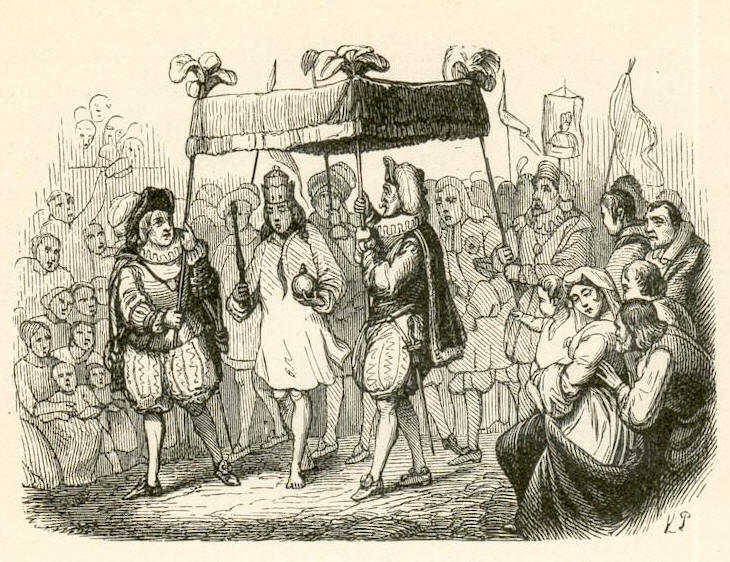 |
| The Emperor, as illustrated by Vilhelm Pedersen |
As you might have guessed, their little experiment yields some unsettling results: no one wants to tell the emperor he's naked, because they're afraid he'll condemn them.
Sound familiar?
Jeff Sessions's testimony before the Senate Intelligence Committee was like a sad, Billy Wilder sequel to that story. The way he squirmed in his seat, equivocating about laws and duties...it was clear he knew he was wrong. Furthermore, I suspect he knows that Trump is wrong, too—surely Jeff Sessions isn't that dumb. But throughout his testimony, I had a tingling suspicion that, no matter what happens, Sessions will take the fall for Trump. He is going down with that ship, no matter what the price.
I'm not saying Sessions didn't break the law, or that his politics aren't repugnant. What I am saying is that Sessions will stop at nothing to protect Trump, even if it means obstructing federal investigations. This frightens me. Is our democracy really so broken that we can't elect leaders who support us?
I don't think so.
I think that, speaking generally, the Russian interference in our 2016 presidential election was an attempt to undermine American faith in our democracy. It's not a perfect system, of course. But if this election has taught us anything, it's that we need to charge unflinchingly ahead within the framework of our existing system. We need to vote, and we need to elect leaders who want us to vote, too. We need leaders who will listen to their constituents and who will accordingly challenge the structure of our government. We need leaders who will speak truth to power, who will modestly admit their shortcomings, who will always strive for a better country.
Throughout this whole post, however, I'm circling the question I don't have an answer to: what about the damn weavers? What's their role in this? Instinct tells me that these weavers are heroes, for several reasons:
- They outsmart the all-powerful emperor.
- They draw attention to the societal inclination to affirm authority figures.
- They're really good at pretending to weave.
Then again, maybe it's time to revise our conceptions of fairy tales.
Monday, May 8, 2017
Fatal Toothpicks and Freebasing Moon Rocks
For close to a year, I have been writing every day.
"Writing" is a term I use loosely. What I really mean to say is "putting some ink on a piece of paper and crossing that act off my mental to-do list." Good days happen, like days when I really get to work on a poem. Those days feel nice. I can take a walk and take deep breaths and fall asleep without feeling antsy.
The majority of what I put on paper, though, is far less substantial. Most days are modest notes, far less likely to stand alone: tiny phrases that catch my ear, drawings of plants, and lots of lists: things I ate, streets I crossed, and descriptions of the voices on which I eavesdropped.
Some days, these notes are instead reminders of strange stories that I encounter. Did you know, for instance, that Sherwood Anderson died because he accidentally ate a toothpick? This was one of my notes on March 29. Please read this if you don't believe me.
While I am proud to make anything on these small days, I would not call them productive. I often leave those days feeling rushed and harried. I am, on the other hand, glad to have a habit like "writing" to anchor myself. Even though I sometimes feel discouraged by the "unproductive" days, it could always be worse. My daily habit could be scrolling without engagement through Perez Hilton, or perhaps freebasing moon rocks.
That's all my long-winded way of telling you that I'm trying to write more. To really make, or at least start making, new things every day. Even if they're immediately abandoned. I will do my best to share those dumb new tiny things on this here blog every once in a while.
Also, an art professor at CVS told me last night that he thinks my apartment is infested with bedbugs. He began speaking to me in Spanish. I responded in Spanish, and then he told me he didn't actually speak much Spanish and that he would prefer not to. I was buying cortisone cream because I've been pretty itchy.
Anyhow, that's been on my mind, so I'm sorry if this post seems a little distracted.
Here's trying.
"Writing" is a term I use loosely. What I really mean to say is "putting some ink on a piece of paper and crossing that act off my mental to-do list." Good days happen, like days when I really get to work on a poem. Those days feel nice. I can take a walk and take deep breaths and fall asleep without feeling antsy.
The majority of what I put on paper, though, is far less substantial. Most days are modest notes, far less likely to stand alone: tiny phrases that catch my ear, drawings of plants, and lots of lists: things I ate, streets I crossed, and descriptions of the voices on which I eavesdropped.
Some days, these notes are instead reminders of strange stories that I encounter. Did you know, for instance, that Sherwood Anderson died because he accidentally ate a toothpick? This was one of my notes on March 29. Please read this if you don't believe me.
While I am proud to make anything on these small days, I would not call them productive. I often leave those days feeling rushed and harried. I am, on the other hand, glad to have a habit like "writing" to anchor myself. Even though I sometimes feel discouraged by the "unproductive" days, it could always be worse. My daily habit could be scrolling without engagement through Perez Hilton, or perhaps freebasing moon rocks.
That's all my long-winded way of telling you that I'm trying to write more. To really make, or at least start making, new things every day. Even if they're immediately abandoned. I will do my best to share those dumb new tiny things on this here blog every once in a while.
Also, an art professor at CVS told me last night that he thinks my apartment is infested with bedbugs. He began speaking to me in Spanish. I responded in Spanish, and then he told me he didn't actually speak much Spanish and that he would prefer not to. I was buying cortisone cream because I've been pretty itchy.
Anyhow, that's been on my mind, so I'm sorry if this post seems a little distracted.
Here's trying.
Wednesday, March 1, 2017
On Death (A Confrontation)
This morning, I woke up at 5:00 with the intent to reflect. I've noticed that, increasingly, I've alienated a lot of brilliant and caring people. There could be lots of reasons for this, but I think terror is a big piece of the puzzle. I'm scared to be honest with other people about how scared I am myself.
Thus, my dumb big Internet confession: I am so uncomfortable with mortality that I'm flailing to confront my own goals and ambitions--which is to say nothing of my relationships. I'm genuinely remorseful for all of the wonderful friendships that have slipped through my fingers, and grateful for the ones who put up with my bullshit. If I made you feel neglected, I am sorry for that most of all. I have felt paralyzed into inaction since I moved back to Kansas City, and am fighting to once again recognize my own capability.
Does anyone else constantly think about these things? How do you reconcile the inevitability of an ending with the potential of a present? How have you recovered from loss? If you have thoughts to share, I'd love to hear them via email, comment, the little "contact" sidebar on this blog, smoke signal, telegram, or any other nearly-outdated form of communication. Let's have a conversation.
I'm perfectly safe and well this morning. I'm sure I'll regret this post as soon as I hit "Publish," but I've also been raised to believe in unflinching honesty.
Thus, my dumb big Internet confession: I am so uncomfortable with mortality that I'm flailing to confront my own goals and ambitions--which is to say nothing of my relationships. I'm genuinely remorseful for all of the wonderful friendships that have slipped through my fingers, and grateful for the ones who put up with my bullshit. If I made you feel neglected, I am sorry for that most of all. I have felt paralyzed into inaction since I moved back to Kansas City, and am fighting to once again recognize my own capability.
Does anyone else constantly think about these things? How do you reconcile the inevitability of an ending with the potential of a present? How have you recovered from loss? If you have thoughts to share, I'd love to hear them via email, comment, the little "contact" sidebar on this blog, smoke signal, telegram, or any other nearly-outdated form of communication. Let's have a conversation.
I'm perfectly safe and well this morning. I'm sure I'll regret this post as soon as I hit "Publish," but I've also been raised to believe in unflinching honesty.
This morning, I focus anew on my present.
Thank you. Much love to you, reader.
Subscribe to:
Posts (Atom)