- "Heart Don't Stand A Chance" by Anderson .Paak, from Malibu (2016)
Showing posts with label 2016. Show all posts
Showing posts with label 2016. Show all posts
Friday, November 17, 2017

Monday, November 6, 2017
Janet
Good morning from Logan! As always, Boston has been good to me: I feel more grounded after catching up with so many people I love and care about.
One of those people—my dear friend Kate—always opens my eyes to new music. (Seriously. In four years, she still hasn't steered me wrong.) Here's one of the discoveries she shared with me this weekend.
- "Janet" by Berhana, from the Berhana EP (2016)
Tuesday, October 24, 2017
Friday, October 20, 2017
Thursday, October 12, 2017
Sudden Impact
Last Friday night, I took a walk to Gillham Park and wandered around the storied old wading pool.
Built in 1977, it replaced an earlier wading pool from 1913. Because this was Kansas City in the '70's, the new pool was heavily informed by Modernist architecture: lots of low, flat, rectilinear concrete planes lead gradually into the shallow pool, which was only three feet at its deepest. This practical design meant that, though there wasn't much shade, parents and friends could nestle into the elevated concrete corners with a clear view of swimmers. It also allowed for closer proximity among strangers, as the segmented planes dictated a certain degree of personal space while still allowing visitors to sit close to one another and, perhaps, strike up a conversation. By many accounts, people felt safe and relaxed here, like they were part of a community.
The pool, which lacked a pumping and filtration system, was eventually shut down last summer after its thirty-ninth year. This represented, for many folks, a significant loss. Gillham Park had one of the few free pools in the city, which meant that it was accessible across socioeconomic boundaries. It was seen as a friendly and welcoming neighborhood space.
Neighborhood groups are currently working to raise money for a nearby spray park. This potential project would be an adequate replacement for the beloved pool, which now sits empty. Its plain white interior has become a free canvas for local artists and bored kids. Though I doubt the pool will remain the gathering space it once was, I'll watch these walls nonetheless.
Built in 1977, it replaced an earlier wading pool from 1913. Because this was Kansas City in the '70's, the new pool was heavily informed by Modernist architecture: lots of low, flat, rectilinear concrete planes lead gradually into the shallow pool, which was only three feet at its deepest. This practical design meant that, though there wasn't much shade, parents and friends could nestle into the elevated concrete corners with a clear view of swimmers. It also allowed for closer proximity among strangers, as the segmented planes dictated a certain degree of personal space while still allowing visitors to sit close to one another and, perhaps, strike up a conversation. By many accounts, people felt safe and relaxed here, like they were part of a community.
The pool, which lacked a pumping and filtration system, was eventually shut down last summer after its thirty-ninth year. This represented, for many folks, a significant loss. Gillham Park had one of the few free pools in the city, which meant that it was accessible across socioeconomic boundaries. It was seen as a friendly and welcoming neighborhood space.
Neighborhood groups are currently working to raise money for a nearby spray park. This potential project would be an adequate replacement for the beloved pool, which now sits empty. Its plain white interior has become a free canvas for local artists and bored kids. Though I doubt the pool will remain the gathering space it once was, I'll watch these walls nonetheless.
 |
| "Bouncy bouncy—it's such a good time" |
 |
| Southbound |
Wednesday, October 11, 2017
Bright Blue Self-Portrait
The below poem, "Bright Blue Self-Portrait," is by the American writer Frank Lima. Born in Spanish Harlem in 1939, Lima's youth was marked by drug addiction, recovery from which led him to realize his love of poetry. After earning an MFA from Columbia University, Lima decided to pursue a career as a chef, though he continued to write until his death in 2013.
Lima was also featured in this painting by Wynn Chamberlain, which features Lima standing behind fellow New York poet Frank O'Hara:
Lima was also featured in this painting by Wynn Chamberlain, which features Lima standing behind fellow New York poet Frank O'Hara:
 |
| Wynn Chamberlain, Poets Dressed and Undressed (1964) |
I thank the spiders’ webs and the circus dancers who stain our eyes with- by Frank Lima, from Incidents of Travel in Poetry (2016)
Rapid movements and authorize our handcuffs to make no distinction
Between night and day or love and hate.
No one will know the sum of our arduous daily separations from bed to
Work. These pillars actually belong to you since I have not counted them
Or know any more than you do where they are or in what country they
Still exist. We can put all our concerns into a loaf of bread and French
Kisses, go to movies and watch the splashing milk on the screen imitate
the forest in the moonlight. Why all the fuss about the patrons becoming
Feathers, discharging their ideas of nobility on the evening news? There
Are no lights in the theater just soft snow from the balcony that is the
Little red schoolhouse where all this began.
Actually it was because of you I did not attend as often as I should have.
I was too embarrassed to face you across the clay modeling tables since I
Always felt like the clay in your hands was a cartoon version of my teen
Years, dear slippery-fish ladies of the sleepy west.
Don’t forget, my early life will be yours, too,
With its self-descriptions of poetic justice,
The tiny creatures we write about can describe themselves in the moss
We leave behind.
Sunday, October 8, 2017
Yo Vivo Con La Verdad
These dudes are just another reason why I'm proud of Kansas City.
- "Yo Vivo Con La Verdad" by Making Movies, from I Am Another You (2017)
Friday, October 6, 2017
Birthright
"Birthright AKA My Father Explains How We Got Here"
I’m not sure how many more times
you want to hear your own myth
The Blue Moon spit you out
which I thought was your first mistake
Son you only get a few resurrections
and you used one already
in a night full of red wings
and light dangling in steam
but hey sometimes we don’t have a choice
in what blood we rode in on
Anyway the cardinal came to the window
and I knew
somewhere something I cared about
was spilling
So I take off running after your mother
a scarlet prayer unraveling behind me
“God, I hope he looks like his mama”
I got in just before the blades
sharp things brought you into this world
sharp things might be what keep you here
they cleaved your mother’s stomach- by Julian Randall, from Vinyl Poetry (July 2016)
like a fresh snowfall
you came from scars boy
if nothing else you get that from me
Tuesday, July 18, 2017
On "Caregiving," Fear, and Growing Up
I recently received the advice to write about my experiences as a “caretaker” for my father after his heart attack. I’m not sure whether I embrace that title, for a variety of reasons. I envision a caregiver as someone who sits by an ill person with a wet washcloth. Not, necessarily, as someone who does all the other small and crucial tasks, like cooking and driving. This logic, however, follows the flawed and ubiquitous notion that domestic work is not valuable. I can rationalize that, and still I feel uncomfortable claiming the position of “caregiver.”
In reality, I often suspect that my parents would have gotten along just fine without me. It might have been slightly more difficult for them, but they would have survived. And I could have just as easily moved someplace else as soon as he was out of the hospital. So why did I stay?
Though I didn’t acknowledge this until recently, my motivations to remain here were entirely selfish: I was terrified of leaving.
Before I dive into that, let me share some context.
The summer before I left for college, my dad spent several weeks in the hospital. At first, he’d developed a simple staph infection. Before long, it spread to his blood, and then his bone marrow. After having a portion of his clavicle removed, he came home to several months of outpatient home care. I learned to change bandages, to clear his PICC line, to inject his medicine twice a day. I learned what a wound vac was, and how unforgettable it smelled. I learned which gauzes and wipes to bring the nurse each afternoon he or she visited. I learned to call 911 when he’d stopped breathing. I learned the comfiest ways to sit in waiting room chairs. I learned to give serious phone calls, and to give cautiously optimistic follow-ups. I learned how to politely respond when people told me, retrospectively, that they didn’t think he’d make it. I learned, finally, to be present with the people I love.
Even if I don’t always act on it, I learned a lot in those three months, and then I went away to learn some more. My dad was cleared for travel not long before I left for school. I’ll never forget his grin when he realized he would be able to see me off to college. He and my mom helped me move into my first dorm room, which I shared with two strangers (and ultimately, two of my closest friends). They said goodbye, and left me to forge my way.
In the sheltered bubble of campus, 1500 miles away, I felt detached. I knew my parents were physically healthy, but I worried constantly about them. After all, they were getting older, and I didn’t know how to cope with that knowledge. On breaks, I would go home to stay with them, eat their food, and hear about everything that had changed while I was away. These moments helped soothe my anxieties, but on some level, I was always conscious that our time together was limited (and perhaps moreso than most).
Of course, this awareness helped me appreciate my parents more, and I’m grateful for that. I’m also grateful for the relationships that were born out of these fears. My first-year roommates, Mikey and Saraphin, had endured similar difficulties during college. We initially bonded because of loss and tribulation. Though our relationship has grown far, far beyond that, I can’t think of many other people who understand my fears the way they do.
That seems like adequate context, so I’ll get back to the “fear of leaving” that spurred this whole post.
A week after graduation, I was already scared of losing my incredible friends and bungling my job search. I didn’t know where I would live, or what I would do. When my mom called me to tell me that Dad was in a coma, every single one of those anxieties paled next to the thought that I might not see my parent again. I flew home the next morning, and I’ve been back in Kansas City since.
Every single day, I wonder where my life would be if I hadn’t gotten that call. Where would I be living? What would I be doing? What other arbitrary fears would I have? I wonder this, and I also wonder whether I’d be so damn thankful to have both of my parents, whether I’d have as many memories with them. Whether I'd have relationships as fulfilling as those that have developed here. Whether I'd feel any differently than I do now.
As I get older, I realize that loss is inevitable, and that fear is always an option. Fear of action, fear of inaction, fear of simply being. This is a part of life, and one that I’m slowly learning to handle. Anxieties cannot dictate the course of my life, but maybe I can lever them to develop a new perspective. To be appreciative of what is, and to accept what is not. To realize what's genuinely important to me. Maybe, one day, I can look certain fears in the face, defy them, and stop feeling so scared.
I’m not there yet, but I get closer every day.
In reality, I often suspect that my parents would have gotten along just fine without me. It might have been slightly more difficult for them, but they would have survived. And I could have just as easily moved someplace else as soon as he was out of the hospital. So why did I stay?
Though I didn’t acknowledge this until recently, my motivations to remain here were entirely selfish: I was terrified of leaving.
Before I dive into that, let me share some context.
The summer before I left for college, my dad spent several weeks in the hospital. At first, he’d developed a simple staph infection. Before long, it spread to his blood, and then his bone marrow. After having a portion of his clavicle removed, he came home to several months of outpatient home care. I learned to change bandages, to clear his PICC line, to inject his medicine twice a day. I learned what a wound vac was, and how unforgettable it smelled. I learned which gauzes and wipes to bring the nurse each afternoon he or she visited. I learned to call 911 when he’d stopped breathing. I learned the comfiest ways to sit in waiting room chairs. I learned to give serious phone calls, and to give cautiously optimistic follow-ups. I learned how to politely respond when people told me, retrospectively, that they didn’t think he’d make it. I learned, finally, to be present with the people I love.
Even if I don’t always act on it, I learned a lot in those three months, and then I went away to learn some more. My dad was cleared for travel not long before I left for school. I’ll never forget his grin when he realized he would be able to see me off to college. He and my mom helped me move into my first dorm room, which I shared with two strangers (and ultimately, two of my closest friends). They said goodbye, and left me to forge my way.
In the sheltered bubble of campus, 1500 miles away, I felt detached. I knew my parents were physically healthy, but I worried constantly about them. After all, they were getting older, and I didn’t know how to cope with that knowledge. On breaks, I would go home to stay with them, eat their food, and hear about everything that had changed while I was away. These moments helped soothe my anxieties, but on some level, I was always conscious that our time together was limited (and perhaps moreso than most).
Of course, this awareness helped me appreciate my parents more, and I’m grateful for that. I’m also grateful for the relationships that were born out of these fears. My first-year roommates, Mikey and Saraphin, had endured similar difficulties during college. We initially bonded because of loss and tribulation. Though our relationship has grown far, far beyond that, I can’t think of many other people who understand my fears the way they do.
That seems like adequate context, so I’ll get back to the “fear of leaving” that spurred this whole post.
A week after graduation, I was already scared of losing my incredible friends and bungling my job search. I didn’t know where I would live, or what I would do. When my mom called me to tell me that Dad was in a coma, every single one of those anxieties paled next to the thought that I might not see my parent again. I flew home the next morning, and I’ve been back in Kansas City since.
Every single day, I wonder where my life would be if I hadn’t gotten that call. Where would I be living? What would I be doing? What other arbitrary fears would I have? I wonder this, and I also wonder whether I’d be so damn thankful to have both of my parents, whether I’d have as many memories with them. Whether I'd have relationships as fulfilling as those that have developed here. Whether I'd feel any differently than I do now.
As I get older, I realize that loss is inevitable, and that fear is always an option. Fear of action, fear of inaction, fear of simply being. This is a part of life, and one that I’m slowly learning to handle. Anxieties cannot dictate the course of my life, but maybe I can lever them to develop a new perspective. To be appreciative of what is, and to accept what is not. To realize what's genuinely important to me. Maybe, one day, I can look certain fears in the face, defy them, and stop feeling so scared.
I’m not there yet, but I get closer every day.
Sunday, July 16, 2017
Intention
I made more accidents! These photos were doubly exposed last summer by simple ignorance. This roll was processed by the knowledgeable folks over at Express Photo. If ever you're in Brookside, be sure to pop in and say hi to Steve.
 |
| Chicago, July '16 / KCMO, August '16 |
Sunday, June 25, 2017
How I Learned to Love My Body Hair
I'm a hairy person. I don't really remember a time when I wasn't. By nine or ten years old, my legs were vertical forests. I wore shorts to school every chance I got. Other kids were mystified by my premature leg hair: did I shampoo it? Did it ever tangle? What did the breeze feel like on my legs?
I was proud.
That changed somewhere around age thirteen, when my pubescent insecurities were especially swollen and tender. A well-meaning loved one, who happened to be a bit further along the stream of adolescence, told me that body hair was a source of shame. The only people who had hairy legs were men, and I wasn't one of those. In order to fit in and be a "normal" girl as I transferred to a new middle school, I had to shave.
So I did. After an hour and two single-blade Bic razors, my legs were smooth (if a little bloody). I proudly felt like I was growing up, though I also felt a heavy sense of loss. Without my hair, I was paradoxically more a "woman" and less a "child."
I continued shaving for years. I would spend an hour in the shower every weekend, trying my hardest to obtain the satiny smooth legs all my female classmates had. At several points, I even used Nair on my arms (my arms!). I had become increasingly ashamed of my own body.
During a routine sports physical toward the end of high school, a clinician noticed my hair. She quickly recommended that I be tested for PCOS, or poly-cystic ovarian syndrome. After the tests came back negative, I instead received an official diagnosis of hirsutism. This was an enormous blow to my teenaged ego: how was I supposed to be a real and beautiful woman if I looked like a werewolf?
Somewhere along the way, though, I realized that beauty, femininity, and body hair were not mutually exclusive. I wish I could point to a singular epiphany, but in reality, I think I just got tired of shaving my legs. I stopped about a year ago, at first as a sort of "screw you" to the patriarchal world outside Wellesley. I wanted to spend my time writing, or playing the guitar, or reading. I didn't want to be forced into diverting my precious attention to my appearance. Plus, it was wintertime so my legs would be mostly, safely hidden. Before long, though, spring reared its colorful head, daring me to maintain the hair that had populated my legs. I could only wear pants for so long.
I stubbornly decided to try not giving a fuck.
The first day I wore a knee-length dress to work, I was beyond uncomfortable. Everyone in my male-dominated workplace could see my hair, exposed and vulnerable. But I stuck it out. Shaving was no longer worthwhile. I hated feeling obligated to use my time in pursuit of an arbitrary beauty standard, one which I hadn't chosen for myself. I hated spending money on razors. I hated being itchy. And I was beginning to enjoy the defiant feeling that grew along with my body hair. I found amusement in each stolen glance at my legs. I could tell that, for a lot of eyes, my swishy dresses and body hair didn't fit into the visual prototype of "feminine."
I loved that.
Months later, my leg hair is still dense. I recently epilated my armpits, an extraordinarily painful and familiar process. I don't regret either decision. As I grow outside the Wellesley bubble, I feel increasingly empowered to make deliberate choices about my appearance. I seldom wear makeup, but when I do, it's because I want to. Following that same logic, I'm confident that if I shave again, I'll do so for my own motivations, and not for anyone else.
There are still plenty of days when I wonder how it would feel to have barren legs, but I've reached a point where my time and money seem too valuable to waste on shaving. My leg hair has become a symbol of my strength, my confidence, and my womanhood. I've reclaimed that loss for my insecure thirteen-year-old self. For the first time in my life, I can say that I'm genuinely unapologetic for my human body and all its hairy splendor.
As I wrap this up, I'm curious to hear other perspectives on grooming, especially as it pertains to gender. Do you shave/wax/epilate/etc.? What are your motivations for/against doing so? Have these changed over time?
Leave a comment and we'll have a conversation.
Thank you for reading this far!
Tuesday, June 13, 2017
The Emperor's New Clothes
Way back in the nineteenth century, Hans Christian Andersen wrote a short story called "The Emperor's New Clothes." (If you're interested, the English translation can be found here.)
The basic vibe, in case you're not inclined to read it, is that these weavers promise to produce magic clothes for an emperor. The weavers tell him that his clothes will appear invisible to anyone who's unworthy. Then the weavers commit some fantastic object-work, pretending to clothe the emperor without actually clothing him. (These weavers probably would have been great at improv. Perhaps they were court jesters in disguise?)
As you might have guessed, their little experiment yields some unsettling results: no one wants to tell the emperor he's naked, because they're afraid he'll condemn them.
Sound familiar?
Jeff Sessions's testimony before the Senate Intelligence Committee was like a sad, Billy Wilder sequel to that story. The way he squirmed in his seat, equivocating about laws and duties...it was clear he knew he was wrong. Furthermore, I suspect he knows that Trump is wrong, too—surely Jeff Sessions isn't that dumb. But throughout his testimony, I had a tingling suspicion that, no matter what happens, Sessions will take the fall for Trump. He is going down with that ship, no matter what the price.
I'm not saying Sessions didn't break the law, or that his politics aren't repugnant. What I am saying is that Sessions will stop at nothing to protect Trump, even if it means obstructing federal investigations. This frightens me. Is our democracy really so broken that we can't elect leaders who support us?
I don't think so.
I think that, speaking generally, the Russian interference in our 2016 presidential election was an attempt to undermine American faith in our democracy. It's not a perfect system, of course. But if this election has taught us anything, it's that we need to charge unflinchingly ahead within the framework of our existing system. We need to vote, and we need to elect leaders who want us to vote, too. We need leaders who will listen to their constituents and who will accordingly challenge the structure of our government. We need leaders who will speak truth to power, who will modestly admit their shortcomings, who will always strive for a better country.
Throughout this whole post, however, I'm circling the question I don't have an answer to: what about the damn weavers? What's their role in this? Instinct tells me that these weavers are heroes, for several reasons:
Then again, maybe it's time to revise our conceptions of fairy tales.
The basic vibe, in case you're not inclined to read it, is that these weavers promise to produce magic clothes for an emperor. The weavers tell him that his clothes will appear invisible to anyone who's unworthy. Then the weavers commit some fantastic object-work, pretending to clothe the emperor without actually clothing him. (These weavers probably would have been great at improv. Perhaps they were court jesters in disguise?)
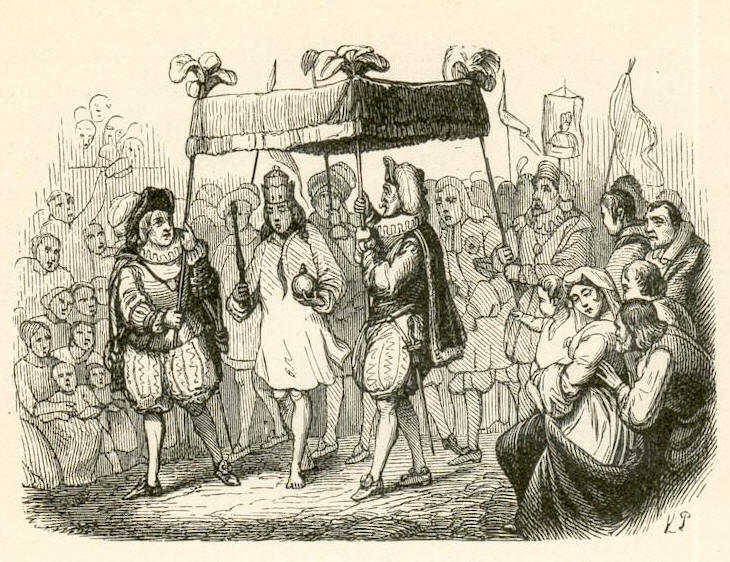 |
| The Emperor, as illustrated by Vilhelm Pedersen |
As you might have guessed, their little experiment yields some unsettling results: no one wants to tell the emperor he's naked, because they're afraid he'll condemn them.
Sound familiar?
Jeff Sessions's testimony before the Senate Intelligence Committee was like a sad, Billy Wilder sequel to that story. The way he squirmed in his seat, equivocating about laws and duties...it was clear he knew he was wrong. Furthermore, I suspect he knows that Trump is wrong, too—surely Jeff Sessions isn't that dumb. But throughout his testimony, I had a tingling suspicion that, no matter what happens, Sessions will take the fall for Trump. He is going down with that ship, no matter what the price.
I'm not saying Sessions didn't break the law, or that his politics aren't repugnant. What I am saying is that Sessions will stop at nothing to protect Trump, even if it means obstructing federal investigations. This frightens me. Is our democracy really so broken that we can't elect leaders who support us?
I don't think so.
I think that, speaking generally, the Russian interference in our 2016 presidential election was an attempt to undermine American faith in our democracy. It's not a perfect system, of course. But if this election has taught us anything, it's that we need to charge unflinchingly ahead within the framework of our existing system. We need to vote, and we need to elect leaders who want us to vote, too. We need leaders who will listen to their constituents and who will accordingly challenge the structure of our government. We need leaders who will speak truth to power, who will modestly admit their shortcomings, who will always strive for a better country.
Throughout this whole post, however, I'm circling the question I don't have an answer to: what about the damn weavers? What's their role in this? Instinct tells me that these weavers are heroes, for several reasons:
- They outsmart the all-powerful emperor.
- They draw attention to the societal inclination to affirm authority figures.
- They're really good at pretending to weave.
Then again, maybe it's time to revise our conceptions of fairy tales.
Wednesday, December 14, 2016
Ode to a Drone
"Ode to a Drone"
Hell-raiser, razor-feathered
risers, windhover over
Peshawar,
power's
joystick-blithe
thousand-mile scythe,
proxy executioner's
proxy ax
pinged by a proxy server,
winged victory,
pilot cipher
unburdened by aught
but fuel and bombs,
fool of God, savage
idiot savant
sucking your benumbedby Amit Majmudar, from Dothead (2016)
trigger-finger
gamer's thumb
Wednesday, November 16, 2016
Free Radical
"Free Radical"
Before Gilgamesh invented
the kaleidoscope and Galileo
the Rubik’s cube, before the
scimitar-horned oryx went
missing, before the tamarind
trees went bare, before the
stars’ eyelids were wrapped
in tinfoil, before the leaves
could gnaw on water, before
electrons made donations,
before the owl wore a mask,
before the wind had a sound,
before the moon had a name
and the smoke a spine, before
the tulips crossed their legs,
before the tongue was
armored, before the ghosts
rode centaurs to riots, before
cyberspace was culled and
belly buttons sown to wombs,
before the taste had an after,
before intellect became
property and thunder
premeditated, before the
New, New World, before a
stone wished to be more
than a stone, before we had a
change of clothes, before the
grass was color-blind, before
the rivers lost their fingers,
and the rain stopped teething,
before the kings were all
beheaded, the gravedigger
neither young nor old, before
a lion was still a lion, before
the girls were all killed, before
the trapeze gave way. We
hung suspended in time
by the arches of our curved
feet and this tickled the gods,
tickled them to death. & I
think our silence cut us loose,
let us go falling from the doubt,
secretly thrilled at the hems
and ever so eager to break.
- by Alison C. Rollins, originally published in Poetry (November 2016)
Tuesday, June 21, 2016
Back from the Dead (+ some stuff I wrote)
I'm exhausted, but I finally have a computer again, so here's to more posts.
My thesis was released online last week. I'm still revising it, and I think it has a way to go. That said, I feel very grateful that this is online, and excited to see what the future holds.
If you're interested, you can find the collection here.
Now I have to go write cover letters, because I graduated and am yet unemployed. (Did I mention that I graduated? There's a lot of catching up to do. I'm not sure where to begin, so I'll just save all that for another time.)
My thesis was released online last week. I'm still revising it, and I think it has a way to go. That said, I feel very grateful that this is online, and excited to see what the future holds.
If you're interested, you can find the collection here.
Now I have to go write cover letters, because I graduated and am yet unemployed. (Did I mention that I graduated? There's a lot of catching up to do. I'm not sure where to begin, so I'll just save all that for another time.)
Tuesday, March 29, 2016
Two Kinds
The second day back from Spring Break, and I'm already overwhelmed. I know that this is a tired chorus by now, and that I probably just feel this way because I got two hours of sleep last night, but I cannot wait to see what the future brings. While Wellesley has been an enormously challenging and beneficial space for me, I'm ready to begin the next step.
But before I get to that point, I have to take care of a few minor things...
But before I get to that point, I have to take care of a few minor things...
- "Two Kinds" by Cullen Omori, from New Misery (2016)
Thursday, February 25, 2016
Famous People and Democracy
Tonight I went to listen to Susan Sarandon talk about why Bernie Sanders is the ideal presidential candidate. I'm very happy to have gone, without a doubt. But I took some beef with the idea that Bernie represents "change" and "acceptance," considering that the whole point of this rally was—like every other rally—to persuade people to vote for him. For instance, his campaign used the social currency of celebrity to convince supposedly intelligent voters of his potential. I respect Susan Sarandon a lot, sure, but I don't know what makes her more of an expert on gun control than, say, any unknown legislative staffer. I would have been way more comfortable had she acknowledged that she was there to use her fame and influence to win votes. There was a lot of Hillary-bashing, too, which was disappointing considering how "positive" a campaign Sanders has been touting. In short, the whole event should have been more honest and transparent about how it functioned.
Maybe more than anything, this event made me realize that it's not necessarily the candidates who are screwed up, but our entire political system. I don't believe that Bernie Sanders can single-handedly fix that. None of the candidates can. People do seem to embrace the idea of a democratic overhaul, which is inspiring. Democracy is an incredible system; we just have to do it better. And that "better" will take a really long time, probably longer than any of us are alive. But consider how much time we dedicate to the (admittedly important) process of scrutinizing our candidates—I spent ten minutes alone just writing the above paragraph, so I'm just as guilty as everyone else. How much better could our country be if we instead spent even half that time looking at the flaws inherent to the democracy within which those candidates function?
 |
| Humble proof for the nonbelievers |
Subscribe to:
Posts (Atom)