Showing posts with label 2012. Show all posts

Tuesday, August 13, 2019

On Female Friendship (or, why I drive with the windows down)

“You can’t take my peace, bitch!” she shouted to the Acura that had cut us off in sweaty, tangled Baltimore traffic. The three of us were driving to the airport after a much-too-brief 48 hours together in deep Maryland, a place where the hot air hung thick and green beneath countless Trump flags and sputtering two-engine planes.

When I say that I’m in love with these women, I mean it in the way of love I’ve felt few times in my life. It’s love, an emotion that no degree of italics could capture. The way I feel for the two of them is doubtlessly deeper and more intertwined than the way I’ve felt for almost all of my romantic partners. It’s an attachment that I suspect most folks are lucky to feel a handful of times in this life, let alone for so long.

What no one ever discusses about this kind of love is that it’s discouragingly difficult. It’s work, and patience, and understanding. It’s waiting three years to see each other because that’s the way life carries you. It’s forgiving one other when you disappear from emails for months at a time, and it’s apologizing to your roommate for laughing so loudly at whatever they just sent to your group text. It's knowing that even if they don't respond right away, they still see your words and feel the warmth of your affection across the miles. It’s FaceTiming in traffic because, yes of course that’s dangerous, but your main bitch is going through a time and you’re going to be there for her. It’s sending them the podcasts and albums and books that made you question yourself. It’s being devastatingly honest, out loud and for the first time, because they know if you’re lying about whatever’s on your mind and they’re not here for empty niceties. It’s holding your breath when you say your goodbyes, because you well know by now just how precious your reunions are.

When I last saw these women, I had joked with them about being emotionally closed off. “I didn’t even cry once this weekend, and I’m angry about it.” We’d spent hours floating in piss-warm water, drinking improvised cocktails and airing out our ideas to dry in the sun of each others’ perspectives. After an intensely trying year away, a year in which I lost several loved ones and in several senses of the verb “lost,” I was ready for an emotional release with them.

But my dramatic, misty-eyed monologue never came. We dove into our own tired souls, dredging up whatever willowy sludge we’d cared to share. I felt immensely self-conscious about how detached I could be in talking about the grief I felt, how coldly I could describe the well of my own confused emotion. I imagined that wasn’t a good sign, and my hyperactive imagination urged me to worry that they saw me as invulnerable, unwilling to be present and raw with them in the same way they had both shared with me. As we piled into the car to part ways, I felt anxious that I had taken our time together for granted.

And then we began driving. It was sweltering outside, a clingy stickiness that only happens when it’s July and you’re underslept and dehydrated from long nights and late swills. The windows were cracked, an overeager breeze stirring the car as if desperate to bring us one last moment of overlap. We were silent. We'd said hardly a word for the entire drive, until the obnoxious Acura swerved ahead of us on I-95 as we meandered south.

In that moment, something broke loose. Pushing her middle finger over the steering wheel, she yelled at the other car, the two of us passengers peppering in colorful comments about the value of serenity and the supremely entitled fuckery of DMV drivers. We began laughing, an overreaction to the humor in a fleeting moment. We couldn’t stop. We had moved beyond words; we were simply together.

As the car’s atmosphere again stilled, the weight of our imminent goodbye again pressing down on us, the speakers opened up. “A tornado flew around my room before you came, excuse the mess it made…” Frank Ocean, a hymn we'd memorized through years of shared history. It was a song that felt like being together again. Each of us knew exactly where the other two were, without speech or sight. This was what it felt like to be with the people you loved.

I looked out at the tiny needled skyline, curving past us, finally welling down the tears I didn’t think I could release. And then a hand. She had reached over, tear-soaked fingers in mine, to wordlessly tell me that she was there too. We stretched our palms into the backseat, the three of us clinging to the present as best we knew how, holding onto each other through the last minutes of the journey.

When I drive my car these days, often alone, I do my best to keep the windows down. I like to smell the leafy, dusty landscapes of the county where I grew up. I abhor the heat, familiar and fervently midwestern, but I enjoy the way it makes my skin feel, salty and stained with just the slightest discomfort. I relish the breeze and all it stirs up in my scalp and in my spirit. I love the way it reminds me of being in that car with the two of them, barreling toward an ending and yet impossibly confident that the wind would still, somehow, carry us back together.


- "Thinkin Bout You," from Frank Ocean's Channel Orange (2012)

Monday, November 20, 2017

Sunday, April 3, 2016

Fue Perfecta

How is it possible that, all at once, I want to both roll around in the snow outside and climb deep into my bed for hours?


-"Fue Perfecta" by Amor Elefante, from Amor Elefante (2012)

Friday, January 29, 2016

Myth

I hated this song the first time I heard it. The introduction felt prickly and dissonant and uncomfortable, but after a few spins, I became a total convert. Even Beach House's bad songs are good, which almost makes it okay that 65% of their stylistic choices and melodies are lifted from Mazzy Star.


- "Myth" by Beach House, from Bloom (2012)

Wednesday, December 9, 2015

Hot Knife

With a music video directed by the inimitable P.T. Anderson.

(Special regards to my friend Sweet Deeks, who shows me 98% of the things I post on this blog.)


- "Hot Knife" by Fiona Apple, from The Idler Wheel... (2012)

Sunday, May 17, 2015

Songs That Were Ripped Off, pt. II

More procrastination, more stolen songs.

The song: "I'm Writing A Novel" by Father John Misty (2012)
    What it ripped off: "The Ballad of John and Yoko" by The Beatles (1969)

Before I write anything else, I want to clarify that I'm an unabashed fan of Father John Misty. My pal Patrick showed me his music a few months ago, and I've been listening to it regularly since. The album Fear Fun is clever, sarcastic, and catchy as all get-out. Plus, Father John Misty got Aubrey Plaza to act in the music video for the song "Hollywood Cemetery Forever Sings," so obviously the guy's doing something right.

But for all the catchy turns and clever lyrics, I noticed that the song "I'm Writing A Novel" sounds unmistakably similar to "The Ballad of John and Yoko" by The Beatles, specifically in the chorus. I'm willing to give the guy a bit of a break, because the lyrics to this song are wonderfully snide and self-deprecating, but he could've changed the melody at least a few notes.

The original:


- "The Ballad of John and Yoko" by The Beatles, released as a single in May 1969

The rip-off:


- "I'm Writing A Novel" by Father John Misty, from Fear Fun (April 2012)

Friday, April 17, 2015

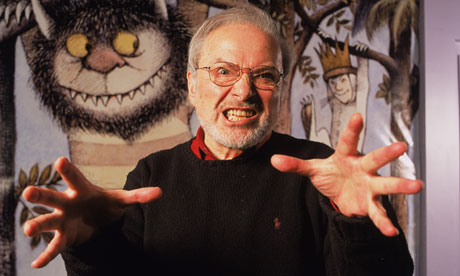
Maurice Sendak Believes

Antonia, the friendly blog ghost, is still doing her job well. As such, she's decided that today will be a day for conversation with Maurice Sendak. The Believer, which is a wonderful magazine that's interviewed people like Philip Seymour Hoffman, Harold Ramis, and Nora Ephron, published this interview with the late writer in 2012, several months after his death. The full piece can be found here, but Antonia has also included an excerpt below, in which Sendak talks about the influence of his family and the effects of losing family members during the Holocaust:

III. WE ARE INSEPARABLE
BLVR: What did your grandmother say about the old country?
MS: She told me about how the Jew-haters would come into her little grocery store and she would push her children down into the cellar. They had a door that closed and they ransacked the whole store. That was pre-Nazi. That was the Cossacks. She came from a little Polish town. My love of Poland is very bleak to this day. I can hear her stories in my head. It was very hard for her. Her husband died when he was forty, which drove my mother crazy. She blamed his death on my grandmother, which is why my grandmother sent her to America—shut up, get outta here. So she came to America. A sixteen-year-old girl, alone. She was told that there would be a pushcart dealer and his wife who would rent her a room and she would have someone to talk to. But shortly after she arrived, he was killed in an automobile accident. I don’t know how she survived. I mean, of course she went nuts. They were all nuts. I knew they were crazy when they came to the house. Crazy faces and wild eyes.
BLVR: Did you have a sense of being American-plus?
MS: Yes. I was very happy to be an American. I loved being here. I loved not being dead when I was a kid. And whenever a kid died, when I was a kid, it was a very big thing; it reflected back on the fact that my being here was arbitrary. My father coming here was arbitrary. He didn’t have to come here. He came because he was chasing a girl who had committed herself to every living human male in the village. And he was the rabbi’s son! He had prestige and was extremely handsome and devil-may-care. He came here and became a drudge. His family was sitting shiva for him back in the old country because he had done this terrible thing: chasing a girl, when your father is a rabbi, and schlepping all the way to New York.
I remember reading that Anne Frank had a friend in America, in Idaho or somewhere, and they exchanged letters. The girl wanted to know why Anne couldn’t come and visit her. The idea that it would have taken only a simple plane trip to save Anne’s life… and the little girl from Idaho didn’t understand that. Why should she? It was very touching to me that it was the plane trip that was the answer to everything. Anne’s death was very hard. All the little-girl playmates that I had in Brooklyn became little Anne Frank girls. And one of them actually became sick and died. I was very confused. I saw that you could die, even in America. That was hard.
So the childhoods of me and my brother and sister were complex. We didn’t know who we were, and whatever we chose to be was seemingly in opposition to what our parents wanted us to be. They wanted us to be wealthy Americans. A doctor, a professor. My sister could be a rich wife. Not much was expected from her, except that she marry well. My sister was so intelligent, and she wanted so much to go to college, but my mother and father said no, she was only a woman, it was a waste of money. I hated the idea of college, and my father was furious because I was the youngest and he could actually pay for me. I was in total revolt. I hated school. I hated forcibly learning something. I had a few understanding teachers who didn’t see me as an evil creature.
BLVR: So where did your curiosity and imagination manifest?
MS: My brother, who was five years my senior. A wonderful, wonderful brother. And my sister. They stood guard over me. They were like the parents I wanted, and behind them, the parents I really had. I mistreated my parents because I didn’t understand their troubles, and then it gets too late.
BLVR: Were they very anxious around you?
MS: Yes. Too anxious. Everything was hard, everything was a problem, everything was a scolding. Everything was you-did-something-wrong. You went around the block, you did something wrong. You spoke to a strange person, you did something wrong. My mother calling me to dinner, “You didn’t go to your brother today, and he’s reading by himself in his room, what kind of brother are you?” He was my savior. He was gentle and wonderful. We wrote stories and I illustrated them on shirt cardboard. And when my relatives—these goofballs—came, he would read the stories and I would hold up the pictures. He wrote a wonderful story called “We Are Inseparable.” About a brother who falls in love with his sister, which my brother did—Freud didn’t know from Brooklyn, he never flew over Brooklyn—and they’re going to get married. My parents didn’t think anything of it.
I remember that story, and I hated drawing the scene where they had to kiss, because I couldn’t fit their faces together. And then at the end—because in the back of his mind he knew something was wrong—the boy is in an accident, with bandages like a mummy, and lying in a hospital bed, and the parents are blocking the bed because she’s a banshee and is going to come, and she rushes in and pushes them aside and jumps on him, and they both hurl themselves out of the forty-second-floor window of the Brooklyn Jewish Hospital screaming, “We are inseparable.” Ha! I had such a good time drawing the bodies falling and smashing. Total wreckage. It was his masterpiece.
BLVR: Did your family know they were crazy?
MS: No. But they led desperate lives. I remember when my brother was dying, he looked at me, and his eyes were all teary. And he said, “Why were we so unkind to Mama?” And I said, “Don’t do that. We were kids, we didn’t understand. We didn’t know she was crazy.” When I asked my best friend, Martin, to have lunch at my house, and my mother walked through the room furiously—she was always furious—he said, “Who’s that?” And I said, “We had to hire somebody.” I would not admit it was my mother. And that shame has lasted all my life. That I didn’t have the nerve to say, “That’s my mother; that’s how she is.”
IV. FOR HE’S A JOLLY GOOD FELLOW
BLVR: Who told you you were talented?
MS: We had a cousin. We were not supposed to like her, because she was a communist. She was very plain. I adored her, and me and my sister would steal off and go to her house. She sat and talked to me and told me that I knew how to draw and that I could be an artist, or anything, and I thought if she was in the world, then good was in the world. Nobody had spoken to me like that. She died when she was young. She married a terrible non-Jew, a really ghastly person. She was the only person who tried to tell me there was more to life than this cuckoo family.
I don’t want to exaggerate to you how bad it was. They were good to me. They tried. They had no education, no experience of life. They came from little shtetls and they were living in America, which was the oddest thing of all. How do you get along with people? You don’t speak En-glish, you haven’t been to school. Your kids are being drawn away from you by society. Their lives were unspeakable. And our lives were between unspeakable and the movies. We had America from the movies and books. In the end, I guess it was OK. I’m totally crazy, I know that. I don’t say that to be a smartass, but I know that—whatever that means—it’s the very essence of what makes my work good. And I know my work is good. Not everybody likes it, that’s fine. I don’t do it for everybody. Or anybody. I do it because I can’t not do it.
BLVR: You were safe in America, but the war in some ways came closer to you and your family than to many of those still in Europe.
MS: Yes. This is true: the day of my bar mitzvah—my father belonged to a Jewish social club—he got word on that day that he had, no longer, a family. Everyone was gone. And he lay down in bed. I remember this so vividly. My mother said to me, “Papa can’t come.” I was going to have the big party at the colonial club, the old mansion in Brooklyn. And I said, “How can Papa not come to my bar mitzvah?” And I screamed at him, “You gotta get up, you gotta get up!” And of course he did. The only thing I remember is looking at him when they broke into “For He’s a Jolly Good Fellow”… And my father’s face was vivid, livid, and I knew I had done something very bad; that I had made him suffer more than he had to. What did I know? This thirteen-year-old ersatz man. Trying to handle fifteen cheap Parker pens.
BLVR: What an inheritance.
MS: Yes. And then you grow up, and you do books for children.


Friday, March 27, 2015

No Moleste

Tig Notaro is a goddess among comedy mortals.

In 2012, a bunch of really bad stuff happened to her: she got pneumonia, and then this super-serious intestinal infection, and then her mom died unexpectedly, and then a big break-up with a long-term partner. Then she found out that she had cancer in both breasts, cancer which soon spread to her lymph nodes.

That's a lot.

But, in an unbelievable spirit of resilience, she decided to do a comedy set about it all. In August of 2012, she performed at Club Largo in Los Angeles, turning her miseries into a remarkably funny stand-up performance. The audio recording was eventually released as the album Live (like imperative verb that means "be alive!" and not like the adjective which means "happening right now"). It's great and I completely recommend it to anyone who hasn't yet heard it but likes to laugh or exist. Here is the set on YouTube.


But if you'd rather not listen to life-affirming jokes about cancer, here is another video of her from the Aspen Rooftop Comedy Festival in 2008. She talks about the "Do Not Disturb" signs in Mexican hotels.

Wednesday, November 26, 2014

Mother and Daughter

This is pretty cool:

Ugne Henriko, a photographer based in Vilnius, Lithuania, recreated a series of photos of her mother from the '70's. The contemporary recreations, with Henriko taking her mother's poses, are astounding.


For the full series and other photos, you should visit Ugne Henriko's website here.