- "Sick Bed Blues" by Skip James, from Greatest of the Delta Blues Singers (1965)
Showing posts with label 1965. Show all posts
Showing posts with label 1965. Show all posts
Thursday, January 7, 2016
Smooth
On the third day, I am still sick. My body feels as though it's trying to exorcise me, but I also have the privilege of being able to sleep excessively without worrying about school or work right now, so it's not nearly as bad as it could be. All things considered, I'm a lucky duck.

Friday, December 18, 2015
Driving a Hearse
I wish I'd known Dennis Hopper, at least after he was sober. He was one hell of an artist.


 |
| Tuesday Weld, 1965 |
 |
| Self-portrait |
Thursday, August 20, 2015
Feeling Good
We're running on adrenaline, and ready for next week. Here is a Nina Simone recording to better your day, which was hopefully pretty alright to begin with.
- "Feeling Good" as recorded by Nina Simone for I Put A Spell On You (1965)
Friday, July 24, 2015
On Photography
In case you were wondering, renting a dunk tank is substantially cheaper than renting a light-up dance floor.
Rental prices aside, I do feel like I'm learning a lot in my job. And if you know anyone who wants to hire me to write things like meeting agendas or poems about corn, please don't hesitate to send them my way. I'm a little serious.
Anyhow, today is Friday, which means cat-sitting and potentially napping after I renew my library books. I've been reading a lot of stuff for my thesis, which is empowering because I feel really smart and accomplished, but also challenging: I'm in the middle of Susan Sontag's Regarding the Pain of Others and just finished her article "On Photography," which makes me question (though only slightly) my aims in taking photos.
In the piece, Sontag argues that all photography is an act of exploitation and voyeurism, and that taking a photo is a way to passively control and encourage a series of events. Her main focus is seems to be war photography, and how great photographers like Robert Capa and Warner Bischof committed morally questionable acts by choosing to photograph conflict rather than intervening. She also makes the claim that photography is also dishonest as a form because it contends to be absolute truth, when in reality it's only a subjective glance from a human perspective. Furthermore, each viewer imposes her own meaning on any visual she sees, regardless of the photographer's intentions or the situational context of the photograph itself.
While I think she has some valuable points, I do think that the idea of photography as objective is problematic on a social level and is not inherent to photography as a form. People are the ones who put labels like "objective" on pieces, and the form cannot be entirely blamed for how it's perceived by a mass audience. It's crucial that photojournalism exists: it's a way of making the "news" (however you choose to define it) relatable and human. When one sees a tangible visual from a war halfway around the world, for instance, it's a little harder for that person to ignore or mindlessly support the war. Those visuals urge the viewer to contemplate, from a moral viewpoint, the situations captured on film (or digitally). Consider the Vietnam War, and how its public support drastically shifted as images poured into television sets in living rooms across the U.S. People couldn't hide from it any longer, and began to voice their concerns with what was seen as unjust and misplaced violence and conflict.
Then again, I wasn't born until twenty-one years after the U.S. withdrew its forces, so I'm probably not the foremost authority on public opinion of the Vietnam War.
Rental prices aside, I do feel like I'm learning a lot in my job. And if you know anyone who wants to hire me to write things like meeting agendas or poems about corn, please don't hesitate to send them my way. I'm a little serious.
Anyhow, today is Friday, which means cat-sitting and potentially napping after I renew my library books. I've been reading a lot of stuff for my thesis, which is empowering because I feel really smart and accomplished, but also challenging: I'm in the middle of Susan Sontag's Regarding the Pain of Others and just finished her article "On Photography," which makes me question (though only slightly) my aims in taking photos.
In the piece, Sontag argues that all photography is an act of exploitation and voyeurism, and that taking a photo is a way to passively control and encourage a series of events. Her main focus is seems to be war photography, and how great photographers like Robert Capa and Warner Bischof committed morally questionable acts by choosing to photograph conflict rather than intervening. She also makes the claim that photography is also dishonest as a form because it contends to be absolute truth, when in reality it's only a subjective glance from a human perspective. Furthermore, each viewer imposes her own meaning on any visual she sees, regardless of the photographer's intentions or the situational context of the photograph itself.
While I think she has some valuable points, I do think that the idea of photography as objective is problematic on a social level and is not inherent to photography as a form. People are the ones who put labels like "objective" on pieces, and the form cannot be entirely blamed for how it's perceived by a mass audience. It's crucial that photojournalism exists: it's a way of making the "news" (however you choose to define it) relatable and human. When one sees a tangible visual from a war halfway around the world, for instance, it's a little harder for that person to ignore or mindlessly support the war. Those visuals urge the viewer to contemplate, from a moral viewpoint, the situations captured on film (or digitally). Consider the Vietnam War, and how its public support drastically shifted as images poured into television sets in living rooms across the U.S. People couldn't hide from it any longer, and began to voice their concerns with what was seen as unjust and misplaced violence and conflict.
Then again, I wasn't born until twenty-one years after the U.S. withdrew its forces, so I'm probably not the foremost authority on public opinion of the Vietnam War.
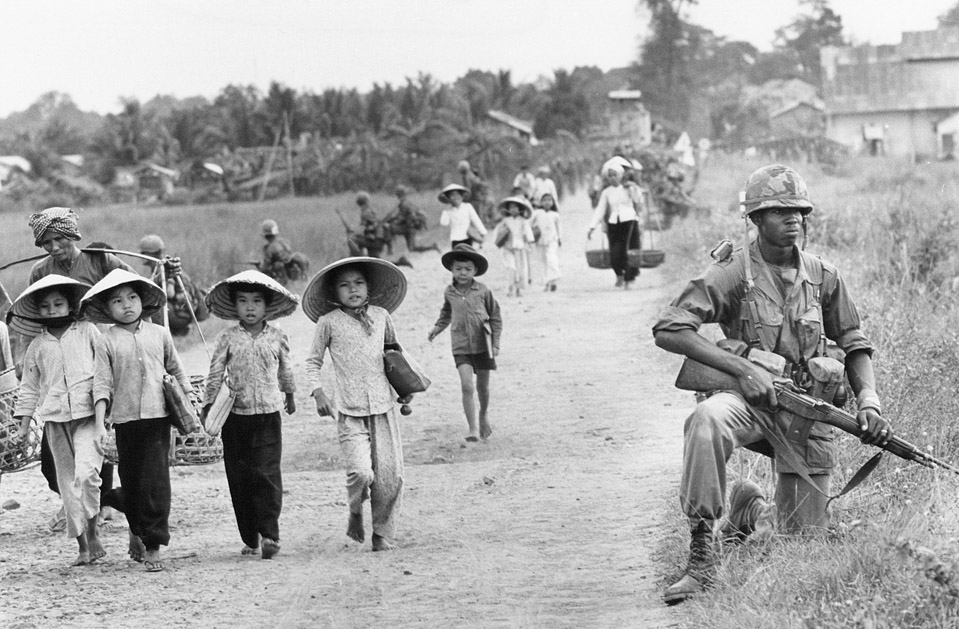 |
| One of Horst Faas's images from the Vietnam War (December 1965) |
Wednesday, July 15, 2015
Five O'Clock World
This is how I feel about Wednesdays.
Maybe I'll spend my lunch break napping by the lake.
Maybe I'll spend my lunch break napping by the lake.
-"Five O'Clock World" by The Vogues, from the album Five O'Clock World (1966)
Monday, July 13, 2015
A Midwestern Summer
So James Tate was a poet who died last Wednesday. I don't really know where to start this post, but that concrete fact seemed as good as anyplace. He was born in Kansas City and did the whole college thing--including a stint at the Iowa Writers' Workshop--before eventually becoming a professor at UMass Amherst in 1971, where he stayed until his death.
His writing has been strangely present around me since then. I hadn't read a single Tate poem until last week, when my dad e-mailed me his obituary. The next day, I went to a poetry reading by Nick Flynn at the MFA. Flynn, whose work I admire quite a bit, was one of Tate's students back in the day, so he read a poem that he'd worked on with him.
 |
| Tate and Gordon Cairnie, one of the founders of The Grolier, as captured by Elsa Dorfman in 1965 |
His writing has been strangely present around me since then. I hadn't read a single Tate poem until last week, when my dad e-mailed me his obituary. The next day, I went to a poetry reading by Nick Flynn at the MFA. Flynn, whose work I admire quite a bit, was one of Tate's students back in the day, so he read a poem that he'd worked on with him.
Not that any of this holds special meaning or significance. I'm aware that it doesn't, and that I have an extreme inclination to over-interpreting symbolism. But the connections were there, and I am a sucker for both poetry and Kansas Citians.
Here is a poem by Tate. Some of its imagery reminds me of simple hot summers in Platte County, where we'd go near the river to swim and to put pennies on the railroad tracks. With nothing better to do, thinking we knew everything, we'd sit and wait for freight trains to come by and blow loud wind, impossibly close, in our hair and ears.
"Success Comes to Cow Creek"
I sit on the tracks,
a hundred feet from
earth, fifty from the
water. Gerald is
inching toward me
as grim, slow, and
determined as a
season, because he
has no trade and wants
none. It’s been nine months
since I last listened
to his fate, but I
know what he will say:
he’s the fire hydrant
of the underdog.
When he reaches my
point above the creek,
he sits down without
salutation, and
spits profoundly out
past the edge, and peeks
for meaning in the
ripple it brings. He
scowls. He speaks: when you
walk down any street
you see nothing but
coagulations
of shit and vomit,
and I’m sick of it.
I suggest suicide;
he prefers murder,
and spits again for
the sake of all the
great devout losers.
A conductor’s horn-From The Lost Pilot (1961)
concerto breaks the
air, and we, two doomed
pennies on the track,
shove off and somersault
like anesthetized
fleas, ruffling the
ideal locomotive
poised on the water
with our light, dry bodies.
Gerald shouts
terrifically as
he sails downstream like
a young man with a
destination. I
swim toward shore as
fast as my boots will
allow; as always,
neglecting to drown.
(Side note: The weekend was, in short: marimba music, cameras, cleaning, and sweet old dogs. Mondays are killer, but I'm trying this new self-imposed bedtime thing. Maybe I'll finally establish some semblance of routine.)
Thanks for reading this, dear friend.
Subscribe to:
Posts (Atom)